Loading
Innovation Center LOGO
Recent ActivityRecent Activity

PID Simulation with Micro800

This application simulates the output of a variable for PID simulation in a Micro800 controller. - [Implementation Time: 30 Minutes]
Innovation Center Home Page
Exploring the Technology Behind SCADA Systems and Their Functionality
Innovation Center LOGO
  • Overview
  • Implementation Guide
  • Download
  • Contact us
  • Subscribe
Innovation Center Home Page
 

What does this application do?

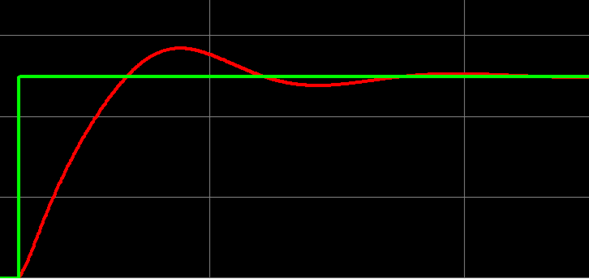
This is a simplified application designed to simulate the behavior of a process variable that can be connected to a PID controller. The application includes executable files that enable this simulation in Connected Components Workbench (CCW) for Micro800 controllers.


pid-simulation-with-micro800_Fig 1.png

pid-simulation-with-micro800_Fig 1


 

AHIC Download ICON VF.png

Downloads

Please note: You will need to agree to the Terms & Conditions for each download.

Downloadable file ›
Legal Disclaimer Acceptance. ROCKWELL AUTOMATION WILL PROVIDE ACCESS TO ROCKWELL PRODUCTS (BEST PRACTICES, APPLICATIONS AND KNOWLEDGE) ON THE CONDITION THAT YOU ACCEPT AND COMPLY WITH THE FOLLOWING TERMS AND CONDITIONS. YOU ACCEPT AND AGREE TO BE BOUND BY THE TERMS OF THIS AGREEMENT BY DOWNLOADING, INSTALLING, COPYING, OR OTHERWISE USING PRODUCTS. IF YOU ARE ACCEPTING THESE TERMS ON BEHALF OF ANOTHER PERSON, COMPANY, OR OTHER LEGAL ENTITY, YOU REPRESENT AND WARRANT THAT YOU HAVE FULL AUTHORITY TO BIND THAT PERSON, COMPANY, OR LEGAL ENTITY TO THESE TERMS. IF YOU DO NOT AGREE TO THESE TERMS, DO NOT DOWNLOAD, INSTALL, COPY, ACCESS, OR USE THE PRODUCTS, SOFTWARE AND/OR CLOUD SERVICES. 1. Rockwell Automation retains full ownership and title to all Products and related documentation. No rights or licenses are granted other than those set forth in this Agreement. Company grants to Rockwell Automation a non-exclusive, worldwide, royalty-free, perpetual, non-revocable license to use any feedback Company provides regarding the Products, even if Company has designated the feedback as confidential. Rockwell Automation will be entitled to use the feedback without restriction or compensation to Company. 2. Company may not lease sub-lease, assign, license, sub-license or otherwise transfer any of the Products without the prior written consent of Rockwell Automation. Company may not assign or otherwise transfer access rights to the Products without the prior written consent of Rockwell Automation. Any reverse assembly, reverse engineering, decompilation, and creation of derivative works based on the Products by Company is prohibited. 3. Company acknowledges that Products provided under this Agreement are Rockwell Automation’s Confidential Information and are covered by effective or pending copyrights, patents, trademarks and/or trade secrets of Rockwell Automation, and Company agrees to maintain confidentiality by not disclosing Products or documentation to any third party without the prior written consent of Rockwell Automation and to protect the confidentiality of the Products as it would Company’s own confidential information. Company agrees that its obligation of confidentiality under this paragraph shall survive expiration or termination of this Agreement. 4. Company agrees that Products provided under this Agreement are prototypes and examples and its application and results may vary depending on each customer and project conditions. Rockwell Automation do not warranty the same results. This Agreement shall in no way be construed as a commitment by Rockwell Automation at any time to manufacture and/or offer Products for sale. There is no explicit or implicit service level agreement associated with using the Products. Rockwell Automation does not warrant that the functions contained in the Products will meet Company’s requirements. Company agrees to use all Products only in accordance with the instructions and only for the intended usages identified in the documentation. 5. EXCLUSION OF WARRANTIES AND LIMITATION OF LIABILITY. THE PRODUCTS ARE PROVIDED "AS IS". ROCKWELL AUTOMATION DISCLAIMS ANY AND ALL WARRANTIES, EXPRESS, IMPLIED OR STATUTORY, INCLUDING WITHOUT LIMITATION ANY WARRANTIES OF MERCHANTABILITY OR FITNESS FOR A PARTICULAR PURPOSE. ROCKWELL AUTOMATION EXPLICITLY DISCLAIMS ALL WARRANTIES OF NON- INFRINGEMENT AND EXPRESSLY DOES NOT WARRANT THAT THE PRODUCTS, IN WHOLE OR IN PART, WILL BE ERROR FREE OR FREE FROM SECURITY VULNERABILITIES. IN NO EVENT SHALL ROCKWELL AUTOMATION BE LIABLE FOR (i) LOST PROFITS, LOST SAVINGS, DOWNTIME, SPECIAL, INDIRECT OR CONSEQUENTIAL DAMAGES OF ANY KIND, OR (ii) ANY PERSONAL INJURY, PROPERTY DAMAGE OR ENVIRONMENTAL DAMAGE ARISING OUT OF OR IN CONNECTION WITH THIS AGREEMENT, WHETHER IN AN ACTION IN CONTRACT, STRICT LIABILITY OR IN TORT INCLUDING NEGLIGENCE. 6. COMPANY AGREES TO INDEMNIFY AND HOLD ROCKWELL AUTOMATION HARMLESS FROM ALL COSTS, AWARDS, DAMAGES, EXPENSES AND FEES (INCLUDING ATTORNEYS FEES) RESULTING FROM OR RELATED TO ANY THIRD-PARTY CLAIMS (INCLUDING EMPLOYEES AND AGENTS OF COMPANY) AGAINST ROCKWELL AUTOMATION, ITS DISTRIBUTORS, AGENTS, OFFICERS, DIRECTORS OR EMPLOYEES FOR PERSONAL INJURY (INCLUDING DEATH), PROPERTY DAMAGE OR ENVIRONMENTAL DAMAGE RELATED TO OR RESULTING FROM THE USE OF THE PRODUCTS. 7. In the event a Product is exported, Company agrees to comply with all applicable United States Export Control Law and Regulations, and the applicable export control laws of other countries. This Agreement shall be governed by the laws of the state of Wisconsin. This Agreement is the complete and exclusive Agreement between Rockwell Automation and the Company, and supersedes all prior agreements, whether written or oral, relating to the Products.
AHIC NEED HELP ICON VF.png


Need Help?

If you need help with an application or have feedback from the Innovation Center, please contact us.

 
  1. General Characteristics
  2. Advantages
Open All Close All
General Characteristics


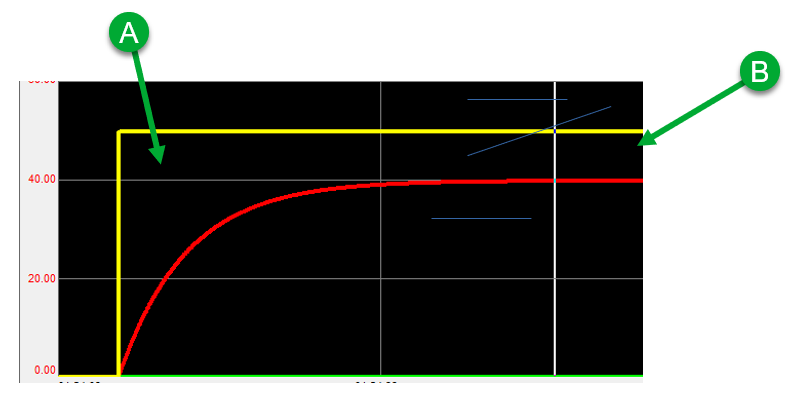
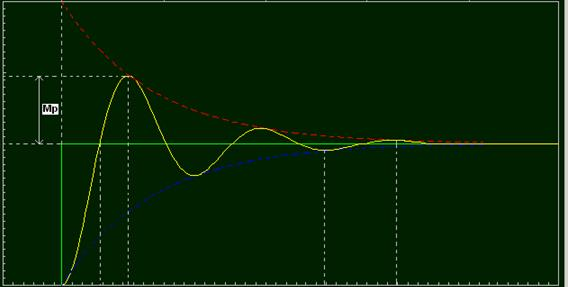
In CCW, there is no built-in Lead-Lag function that would allow us to simulate a process with behavior similar to that shown in the following image, therefore, the simulation will be implemented by constructing a first-order filter, as described in the following steps.


A Phase lag (Lag)
B Steady-state error
pid-simulation-with-micro800_Fig 2.png

pid-simulation-with-micro800_Fig 2

Advantages


  • Simplified code
  • Ease of implementation
  • Impact on development time
  • Cost reduction
  • Operational efficiency
  • Enables simulation and study in a safe environment


Is this application relevant to me?

This application can be used in CCW with Micro800 controllers. It allows users to understand the effects of PID gains and various configuration parameters, as well as simulate simple processes for demonstration purposes or virtual commissioning.


How can I make it work?

Requirements: products, tools, prior knowledge.

Hardware

  • Micro800 controllers (or simulation software)

Software

  • Connected Components Workbench (V23.0→)

Prior Knowledge

  • Basic knowledge of Connected Components Workbench
  • Knowledge of PID closed-loop control systems
 

Links of Interest (internal or external)

  • https://literature.rockwellautomation.com/idc/groups/literature/documents/br/2080-br001_-es-p.pdf
  • https://www.rockwellautomation.com/en-us/capabilities/industrial-automation-control/design-and-configuration-software.html


AHIC STEP ICON.png

Implementation Guide

 
  1. Step 1
  2. Step 2
  3. Step 3
  4. Step 4
  5. Step 5
  6. Conclusion
Open All Close All
Step 1
 

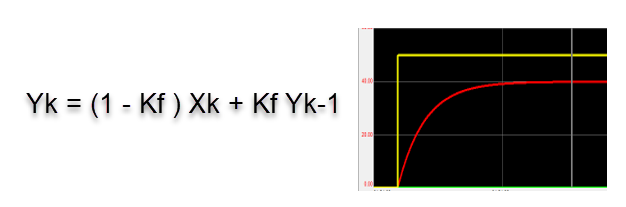
In the case of CCW, the Phase Lead-Lag instruction is not available; therefore, the code will be written to implement a first-order filter based on the following equation:
 

pid-simulation-with-micro800_Fig 3.png

pid-simulation-with-micro800_Fig 3

Step 2
 

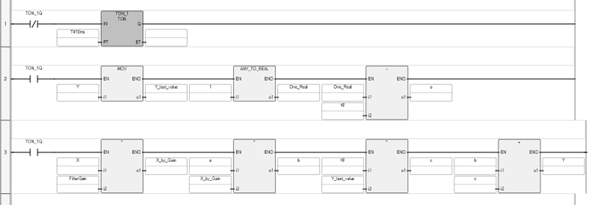
Insert the following code in Ladder Logic.

Since this first-order filter operates as a function of time, the TON timer provides the trigger required to perform the filter calculations.

For this application, we recommend using a timer value of 10 ms, although this value can be adjusted according to the dynamics of the process being simulated.
 

pid-simulation-with-micro800_Fig 4.png

pid-simulation-with-micro800_Fig 4

Step 3
 

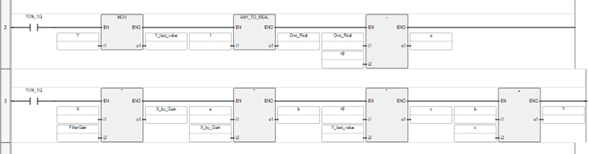
The remaining blocks perform the arithmetic operations required to implement the filter equation. In this application, variable “X” represents the input variable, and variable “Y” represents the output variable (both tags are of the Real data type).

For this example, which uses a 10 ms execution time, we recommend using a gain value of Kf = 0.993. However, this value can be adjusted according to the process being simulated.
 

pid-simulation-with-micro800_Fig 5.png

pid-simulation-with-micro800_Fig 5

Step 4
 

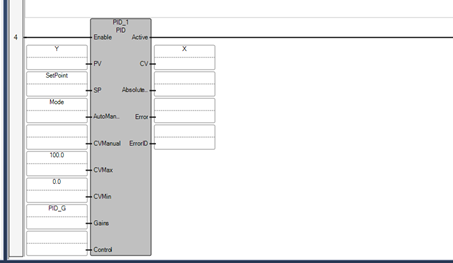
Add a PID function. Configure tag “Y” as the PID input (PV) and tag “X” as the PID output (CV).
 

pid-simulation-with-micro800_Fig 6.png

pid-simulation-with-micro800_Fig 6

Step 5
 

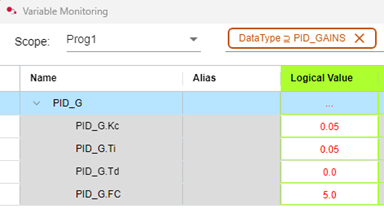
Adjust the parameters and gains according to the process being simulated.

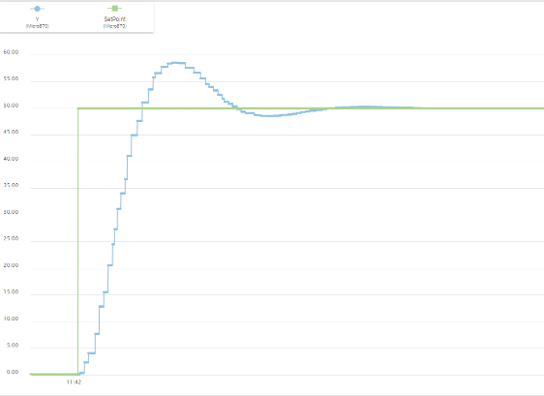
To obtain a response similar to the one shown in the following image, it is recommended to use the following gain values:
 

pid-simulation-with-micro800_Fig 7.png

pid-simulation-with-micro800_Fig 7

pid-simulation-with-micro800_Fig 8.png

pid-simulation-with-micro800_Fig 8

Conclusion
 

With this parameterization, it is possible to achieve the behavior of an underdamped system with approximately 20% overshoot and stabilization within three half-cycles.

However, the parameters can be adjusted to obtain any desired response according to the process being simulated.
  • 0<𝜁<1 Underdamped System
  • 𝜁 = 1 Critically Damped System
  • 𝜁 > 1 Overdamped System
     
pid-simulation-with-micro800_Fig 9.png

pid-simulation-with-micro800_Fig 9


PID Simulation with Micro800

Version 2.0 - October 2026

 
AHIC White Logo

Receive new applications and Innovation Center updates directly in your inbox.

Subscribe!
  1. Chevron LeftChevron Left Rockwell Automation Home
  2. Chevron LeftChevron Left Sup...
  3. Chevron LeftChevron Left Pro...
  4. Chevron LeftChevron Left Downloads
  5. Chevron LeftChevron Left Innovation Center
  6. Chevron LeftChevron Left PID Simulation with Micro800
Please update your cookie preferences to continue.
This feature requires cookies to enhance your experience. Please update your preferences to allow for these cookies:
  • Social Media Cookies
  • Functional Cookies
  • Performance Cookies
  • Marketing Cookies
  • All Cookies
You can update your preferences at any time. For more information please see our {0} Privacy Policy
CloseClose