Loading
Innovation Center LOGO
Recent ActivityRecent Activity

Control of pH Based on a Wiener Model

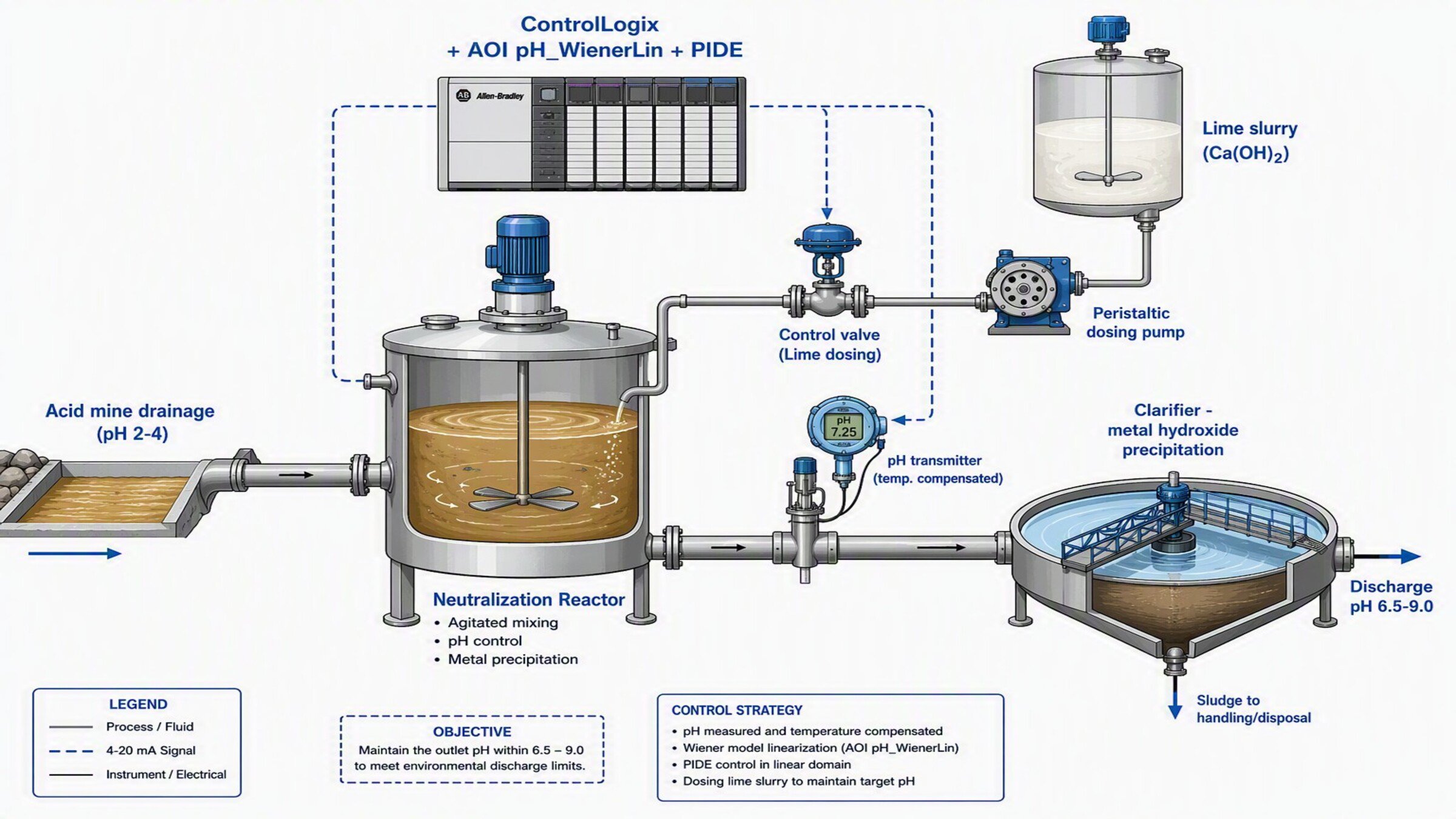
Control a highly nonlinear pH loop using Wiener model linearization and PIDE regulatory control. Includes the linearization AOI, PIDE, and call routine running entirely in the Logix controller. - [Implementation Time: 30 minutes]
Innovation Center Home Page
control-of-ph-based-on-a-wiener-model_16x9-phControl_header.jpg

Innovation Center LOGO
  • Overview
  • Implementation Guide
  • Download
  • Contact us
  • Subscribe
Innovation Center Home Page


What does this application do?

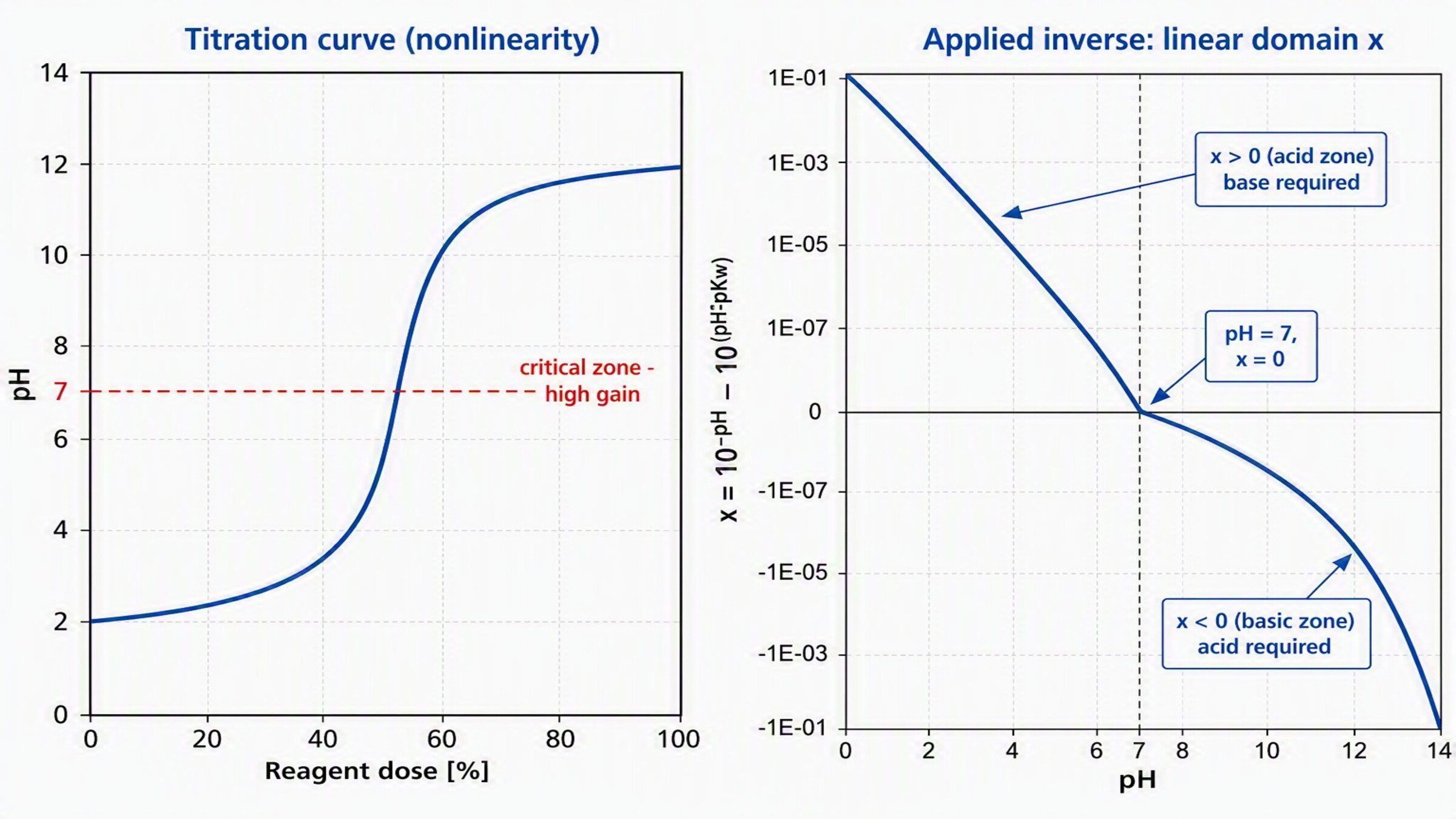
Used to control a pH loop whose reagent→pH relationship is an S-shaped (nonlinear) titration curve. The AOI applies the inverse of the nonlinearity to the Setpoint and the Process Variable, allowing the loop to be closed with a linear PIDE that performs stably across the entire pH range (acid, neutral and basic).


control-of-ph-based-on-a-wiener-model_16x9-phControl_header.jpg

control-of-ph-based-on-a-wiener-model_16x9-phControl_header.jpg

control-of-ph-based-on-a-wiener-model_16x9-phControl_header.jpg

control-of-ph-based-on-a-wiener-model_16x9-phControl_header.jpg


General Features

This development includes the following:

  • pH_WienerLin Add-On Instruction (Wiener linearization) in Studio 5000
  • Preconfigured PIDE instruction for control in the linear domain
  • Call routine and associated tags


Advantages:

  • Provides an initial reference for the control of highly nonlinear processes (pH, neutralization)
  • Enables stable performance without re-tuning the controller when changing pH zone


Limitations/Disadvantages

  • Limited to a SISO loop (one controlled variable, one manipulated variable); for multivariable control with constraints, PlantPAx MPC is recommended
  • Requires prior identification of the titration curve for PWL mode


AHIC Download ICON VF.png

Downloads

Please note: You will need to agree to the Terms & Conditions for each download.

Downloadable file ›
Legal Disclaimer Acceptance. ROCKWELL AUTOMATION WILL PROVIDE ACCESS TO ROCKWELL PRODUCTS (BEST PRACTICES, APPLICATIONS AND KNOWLEDGE) ON THE CONDITION THAT YOU ACCEPT AND COMPLY WITH THE FOLLOWING TERMS AND CONDITIONS. YOU ACCEPT AND AGREE TO BE BOUND BY THE TERMS OF THIS AGREEMENT BY DOWNLOADING, INSTALLING, COPYING, OR OTHERWISE USING PRODUCTS. IF YOU ARE ACCEPTING THESE TERMS ON BEHALF OF ANOTHER PERSON, COMPANY, OR OTHER LEGAL ENTITY, YOU REPRESENT AND WARRANT THAT YOU HAVE FULL AUTHORITY TO BIND THAT PERSON, COMPANY, OR LEGAL ENTITY TO THESE TERMS. IF YOU DO NOT AGREE TO THESE TERMS, DO NOT DOWNLOAD, INSTALL, COPY, ACCESS, OR USE THE PRODUCTS, SOFTWARE AND/OR CLOUD SERVICES. 1. Rockwell Automation retains full ownership and title to all Products and related documentation. No rights or licenses are granted other than those set forth in this Agreement. Company grants to Rockwell Automation a non-exclusive, worldwide, royalty-free, perpetual, non-revocable license to use any feedback Company provides regarding the Products, even if Company has designated the feedback as confidential. Rockwell Automation will be entitled to use the feedback without restriction or compensation to Company. 2. Company may not lease sub-lease, assign, license, sub-license or otherwise transfer any of the Products without the prior written consent of Rockwell Automation. Company may not assign or otherwise transfer access rights to the Products without the prior written consent of Rockwell Automation. Any reverse assembly, reverse engineering, decompilation, and creation of derivative works based on the Products by Company is prohibited. 3. Company acknowledges that Products provided under this Agreement are Rockwell Automation’s Confidential Information and are covered by effective or pending copyrights, patents, trademarks and/or trade secrets of Rockwell Automation, and Company agrees to maintain confidentiality by not disclosing Products or documentation to any third party without the prior written consent of Rockwell Automation and to protect the confidentiality of the Products as it would Company’s own confidential information. Company agrees that its obligation of confidentiality under this paragraph shall survive expiration or termination of this Agreement. 4. Company agrees that Products provided under this Agreement are prototypes and examples and its application and results may vary depending on each customer and project conditions. Rockwell Automation do not warranty the same results. This Agreement shall in no way be construed as a commitment by Rockwell Automation at any time to manufacture and/or offer Products for sale. There is no explicit or implicit service level agreement associated with using the Products. Rockwell Automation does not warrant that the functions contained in the Products will meet Company’s requirements. Company agrees to use all Products only in accordance with the instructions and only for the intended usages identified in the documentation. 5. EXCLUSION OF WARRANTIES AND LIMITATION OF LIABILITY. THE PRODUCTS ARE PROVIDED "AS IS". ROCKWELL AUTOMATION DISCLAIMS ANY AND ALL WARRANTIES, EXPRESS, IMPLIED OR STATUTORY, INCLUDING WITHOUT LIMITATION ANY WARRANTIES OF MERCHANTABILITY OR FITNESS FOR A PARTICULAR PURPOSE. ROCKWELL AUTOMATION EXPLICITLY DISCLAIMS ALL WARRANTIES OF NON- INFRINGEMENT AND EXPRESSLY DOES NOT WARRANT THAT THE PRODUCTS, IN WHOLE OR IN PART, WILL BE ERROR FREE OR FREE FROM SECURITY VULNERABILITIES. IN NO EVENT SHALL ROCKWELL AUTOMATION BE LIABLE FOR (i) LOST PROFITS, LOST SAVINGS, DOWNTIME, SPECIAL, INDIRECT OR CONSEQUENTIAL DAMAGES OF ANY KIND, OR (ii) ANY PERSONAL INJURY, PROPERTY DAMAGE OR ENVIRONMENTAL DAMAGE ARISING OUT OF OR IN CONNECTION WITH THIS AGREEMENT, WHETHER IN AN ACTION IN CONTRACT, STRICT LIABILITY OR IN TORT INCLUDING NEGLIGENCE. 6. COMPANY AGREES TO INDEMNIFY AND HOLD ROCKWELL AUTOMATION HARMLESS FROM ALL COSTS, AWARDS, DAMAGES, EXPENSES AND FEES (INCLUDING ATTORNEYS FEES) RESULTING FROM OR RELATED TO ANY THIRD-PARTY CLAIMS (INCLUDING EMPLOYEES AND AGENTS OF COMPANY) AGAINST ROCKWELL AUTOMATION, ITS DISTRIBUTORS, AGENTS, OFFICERS, DIRECTORS OR EMPLOYEES FOR PERSONAL INJURY (INCLUDING DEATH), PROPERTY DAMAGE OR ENVIRONMENTAL DAMAGE RELATED TO OR RESULTING FROM THE USE OF THE PRODUCTS. 7. In the event a Product is exported, Company agrees to comply with all applicable United States Export Control Law and Regulations, and the applicable export control laws of other countries. This Agreement shall be governed by the laws of the state of Wisconsin. This Agreement is the complete and exclusive Agreement between Rockwell Automation and the Company, and supersedes all prior agreements, whether written or oral, relating to the Products.
AHIC NEED HELP ICON VF.png


Need Help?

If you need help with an application or have feedback from the Innovation Center, please contact us.


Is this application relevant to me?

If you need to control a pH or neutralization loop where a conventional PID oscillates, overshoots or overdoses reagent.


Application áreas - Can be applied in water treatment, effluent neutralization, chemical industry, food and beverage.


How can I make it work?

Requirements: products, tools, prior knowledge.

Hardware

  • Any Logix controller (the program is tested on a 1756-L81E ControlLogix 5580)
  • pH transmitter with temperature compensation
  • Final element: control valve or reagent dosing pump

Software

  • Studio 5000 (the program is developed in version 37)
  • MS Excel

Prior Knowledge

Basic knowledge of programming and configuration in:

  • Studio 5000 (Add-On Instructions, PIDE instruction, Structured Text)
  • Process regulatory control
  • pH control fundamentals / Wiener models


AHIC STEP ICON.png

Implementation Guide

 
  1. Step 1
  2. Step 2
  3. Step 3
  4. Step 4
  5. Step 5
  6. Step 6
  7. Step 7
  8. Step 8
  9. Step 9
  10. Step 10
  11. Step 11
Open All Close All
Step 1


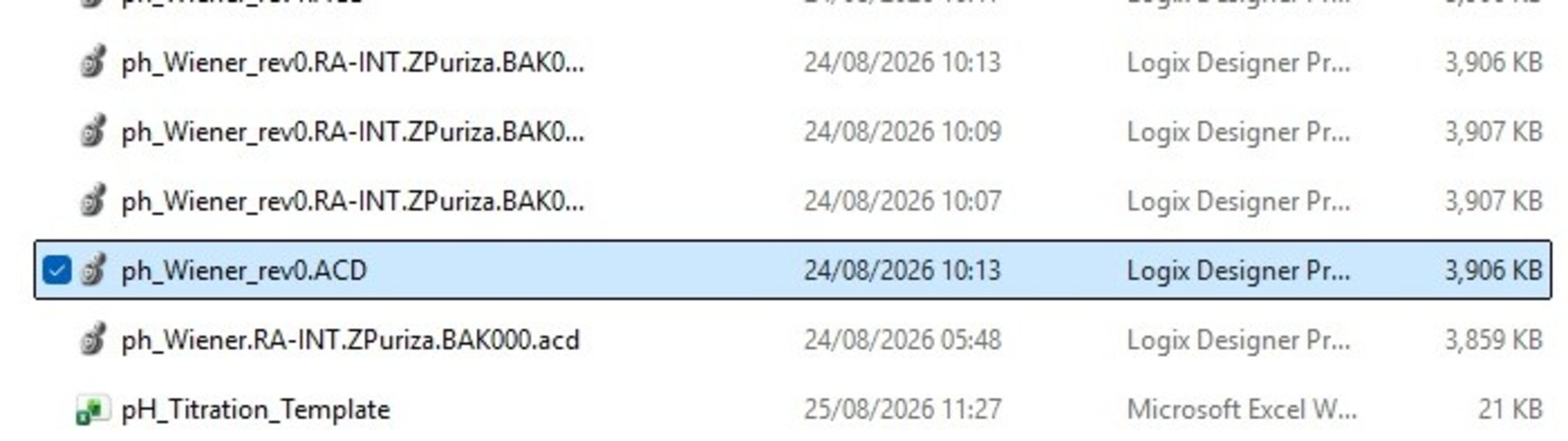
Extract and open Extract the files of the delivered program (".ACD" project).


control-of-ph-based-on-a-wiener-model_16x9-phControl_step1_imagen1.jpg

control-of-ph-based-on-a-wiener-model_16x9-phControl_step1_imagen1.jpg


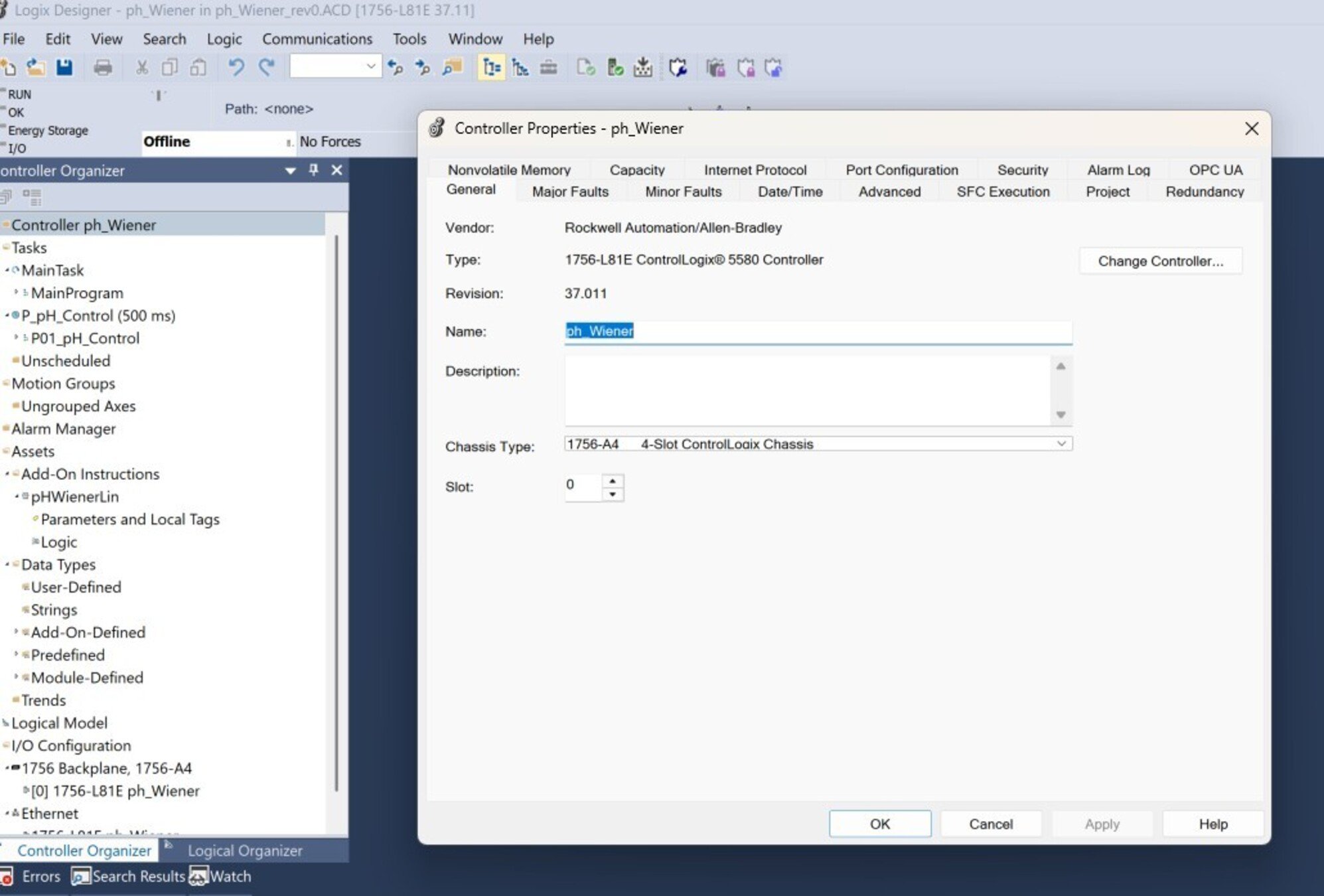
Open the Studio 5000 program by double-clicking the .ACD file. For testing this application, a ControlLogix 5580 controller (1756-L81E) was used. 


control-of-ph-based-on-a-wiener-model_16x9-phControl_step1_imagen2.jpg

control-of-ph-based-on-a-wiener-model_16x9-phControl_step1_imagen1.jpg

Step 2


Understand the program structure. Review the main components of the program in the "Controller Organizer":

  • pH_WienerLin: Linearizes pH by applying the inverse of the titration curve
  • pH_PIDE (PID_ENHANCED): Regulatory control in the linear domain
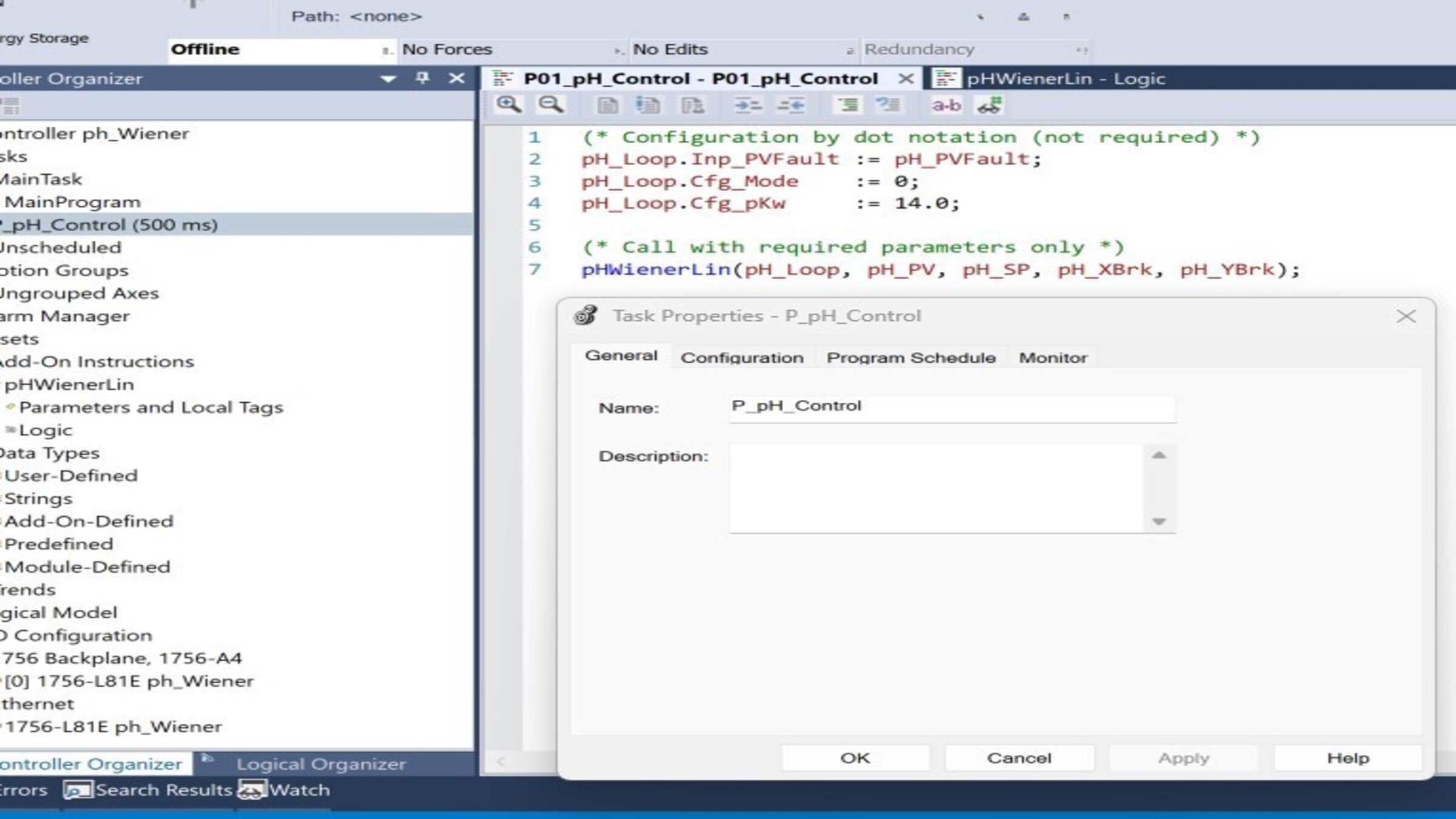
  • Program P_pH_Control: Contains the call routine
  • Task T_Process: Periodic task that executes the control
 
control-of-ph-based-on-a-wiener-model_16x9-phControl_step2_imagen1.jpg

control-of-ph-based-on-a-wiener-model_16x9-phControl_step2_imagen1.jpg

Step 3


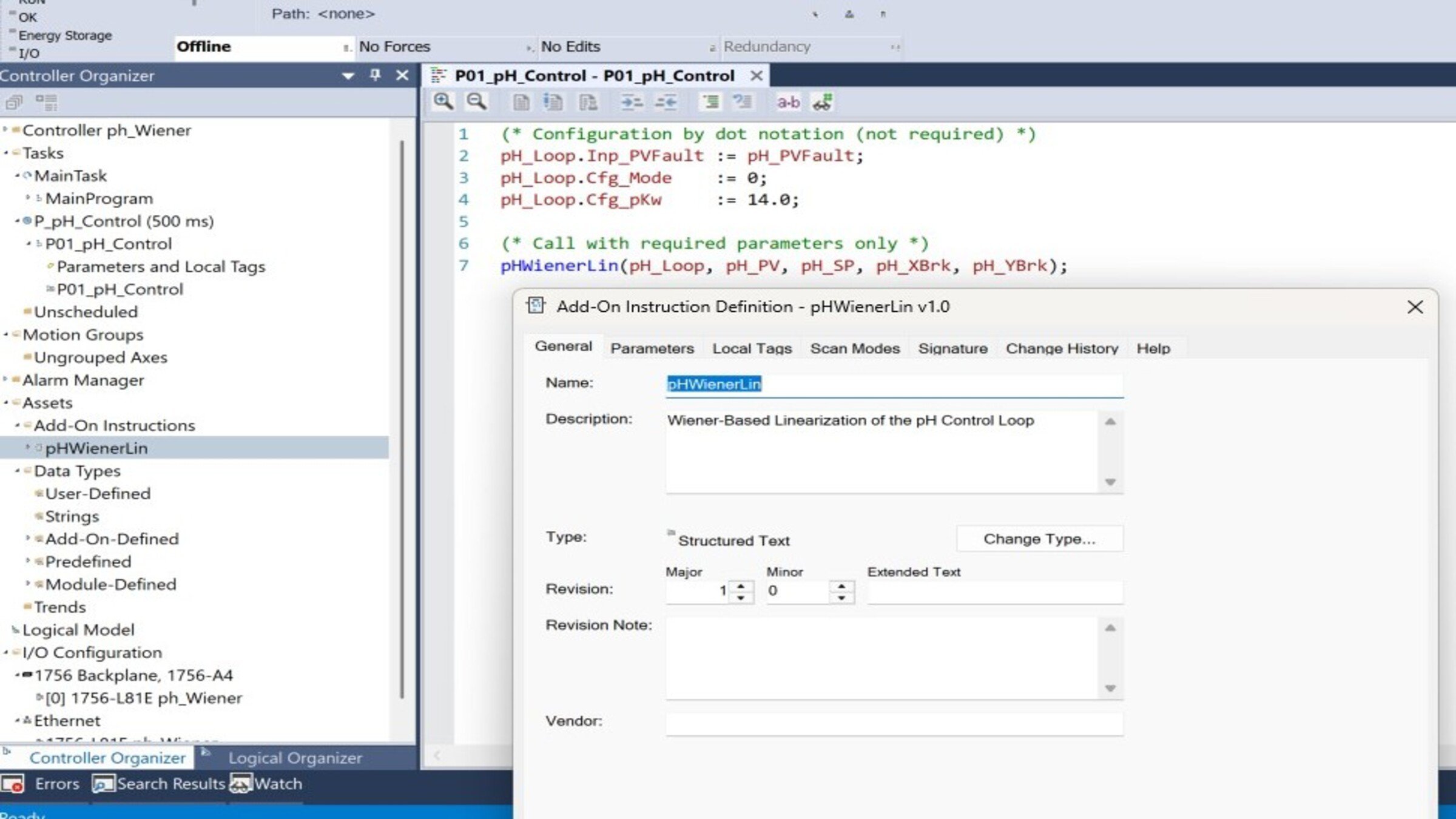
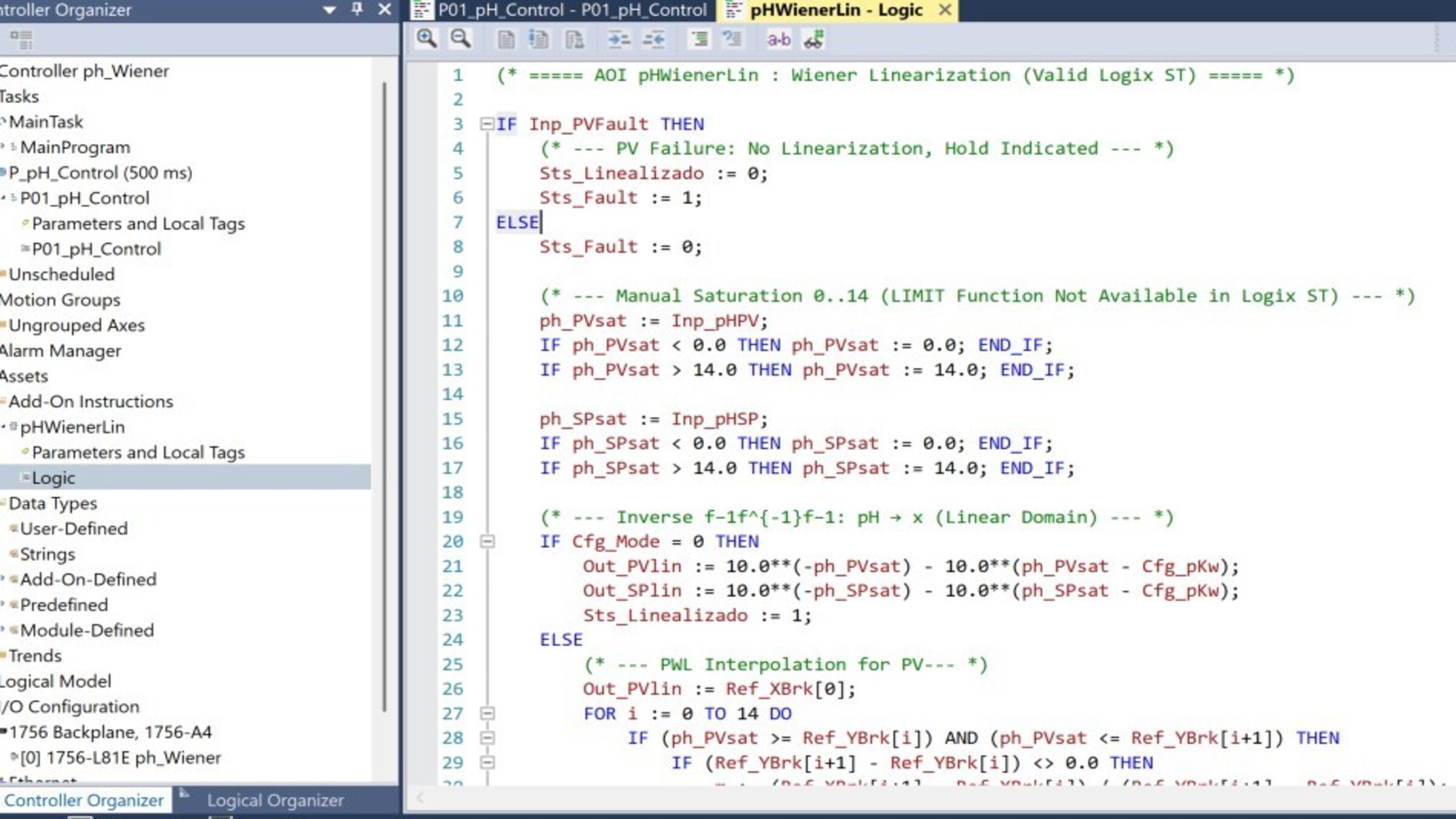
Understand the pH_WienerLin AOI

  • Open the AOI in the Controller Organizer and review the Logic tab.
  • The AOI transforms pH into the linear domain x through the inverse of the nonlinearity: x=10−pH−10(pH−pKw)x = 10^{-pH} - 10^{(pH - pK_w)}x=10−pH−10(pH−pKw)
  • It delivers two outputs: Out_SPlin (linearized SP) and Out_PVlin (linearized PV), which feed the PIDE. The Cfg_Mode parameter selects the method: 0 = analytical inverse; 1 = PWL table (actual titration curve).


control-of-ph-based-on-a-wiener-model_16x9-phControl_step3_imagen1.jpg

control-of-ph-based-on-a-wiener-model_16x9-phControl_step3_imagen1.jpg

Step 4


Understand the call routine. In the P_pH_Control routine, verify the execution sequence:


control-of-ph-based-on-a-wiener-model_16x9-phControl_step4_imagen1.jpg

control-of-ph-based-on-a-wiener-model_16x9-phControl_step4_imagen1.jpg

Step 5


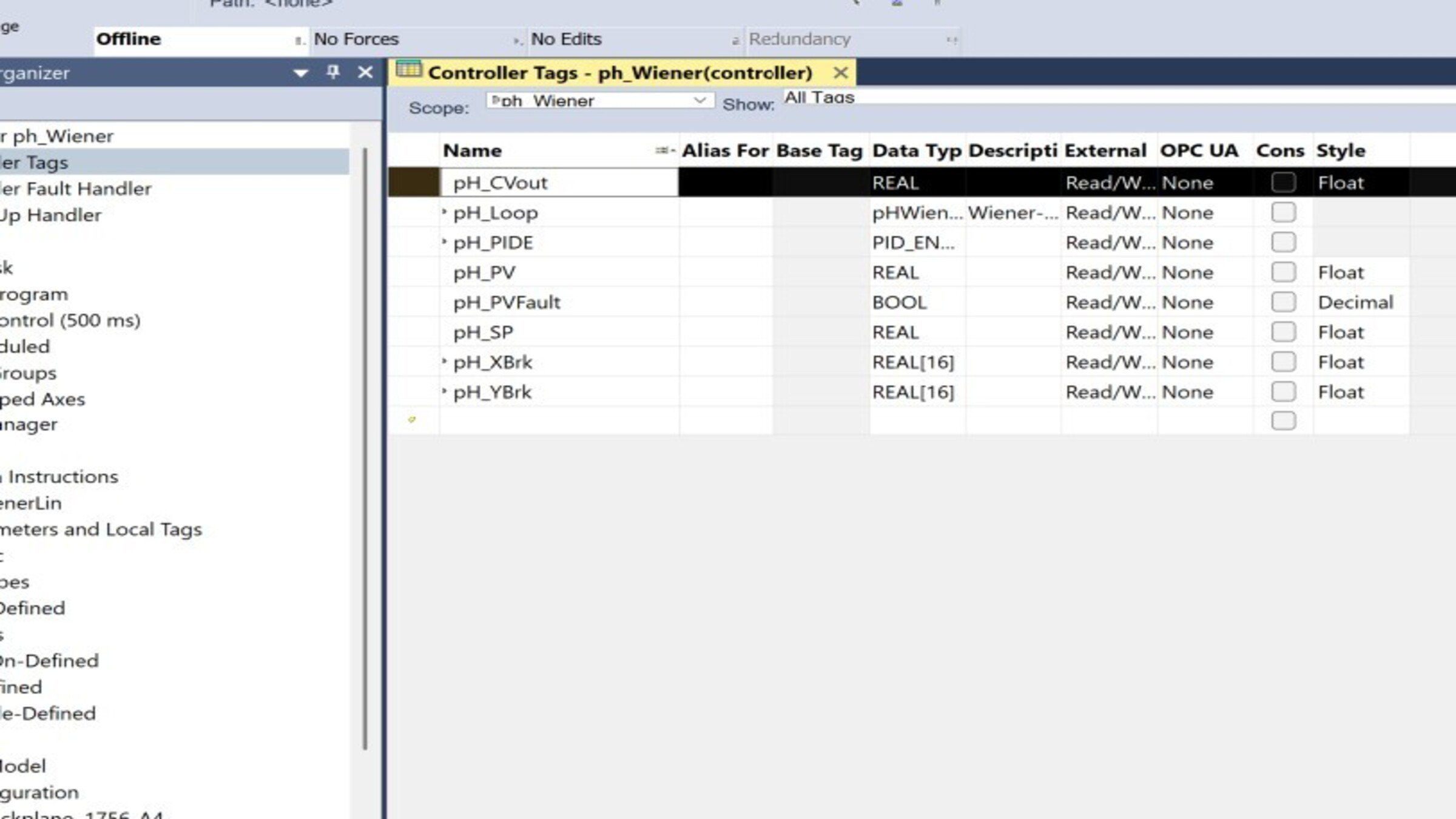
Configure the field tags (I/O mapping). Link the program tags to your input/output modules:

Tag Type Link to
pH_CVout REAL Analog output to valve/pump
pH_PVFault BOOL Channel diagnostics / transmitter fault
pH_SP REAL Setpoint (initial value 7.0)
pH_PV REAL Analog input from the pH transmitter


control-of-ph-based-on-a-wiener-model_16x9-phControl_step5_imagen1.jpg

control-of-ph-based-on-a-wiener-model_16x9-phControl_step5_imagen1.jpg

Step 6


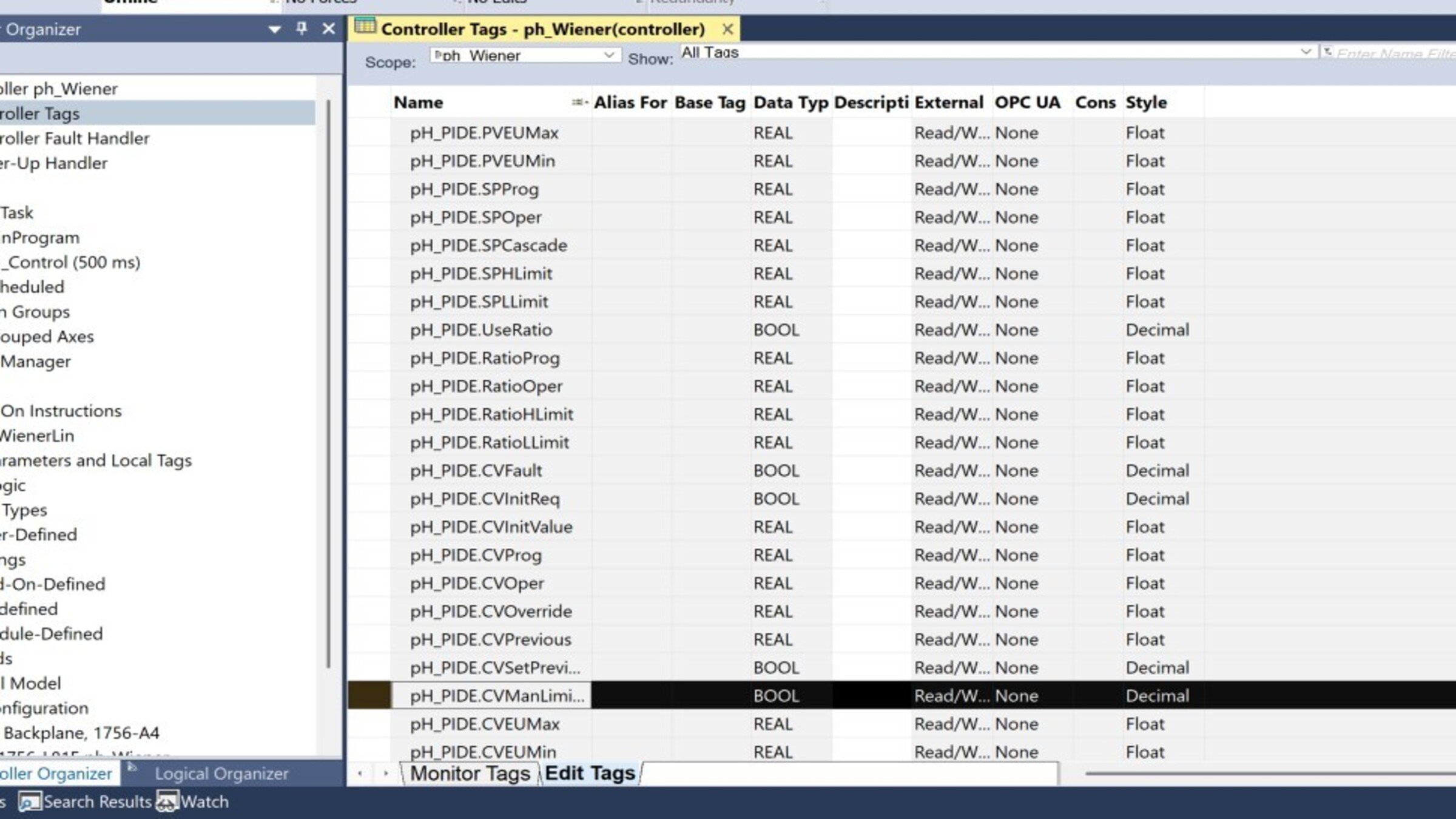
Configure the PIDE instructions.

Open the properties of pH_PIDE and adjust:

Parameters
Recommended value
Issue – Action Taken
CVEUMax / CVEUMin
100 / 0 %
Valve/Pump Output Range
PVEUMax / PVEUMin
+0.1 / −0.1
Linear Domain Scaling (Adjust to Match Your Curve)
PGain / IGain
1.2 / 0.05 (seed value)
Retune After Model Identification
DGain
0 Common for pH Loops Due to Measurement Noise.
 
control-of-ph-based-on-a-wiener-model_16x9-phControl_step6_imagen1.jpg

control-of-ph-based-on-a-wiener-model_16x9-phControl_step6_imagen1.jpg

Step 7


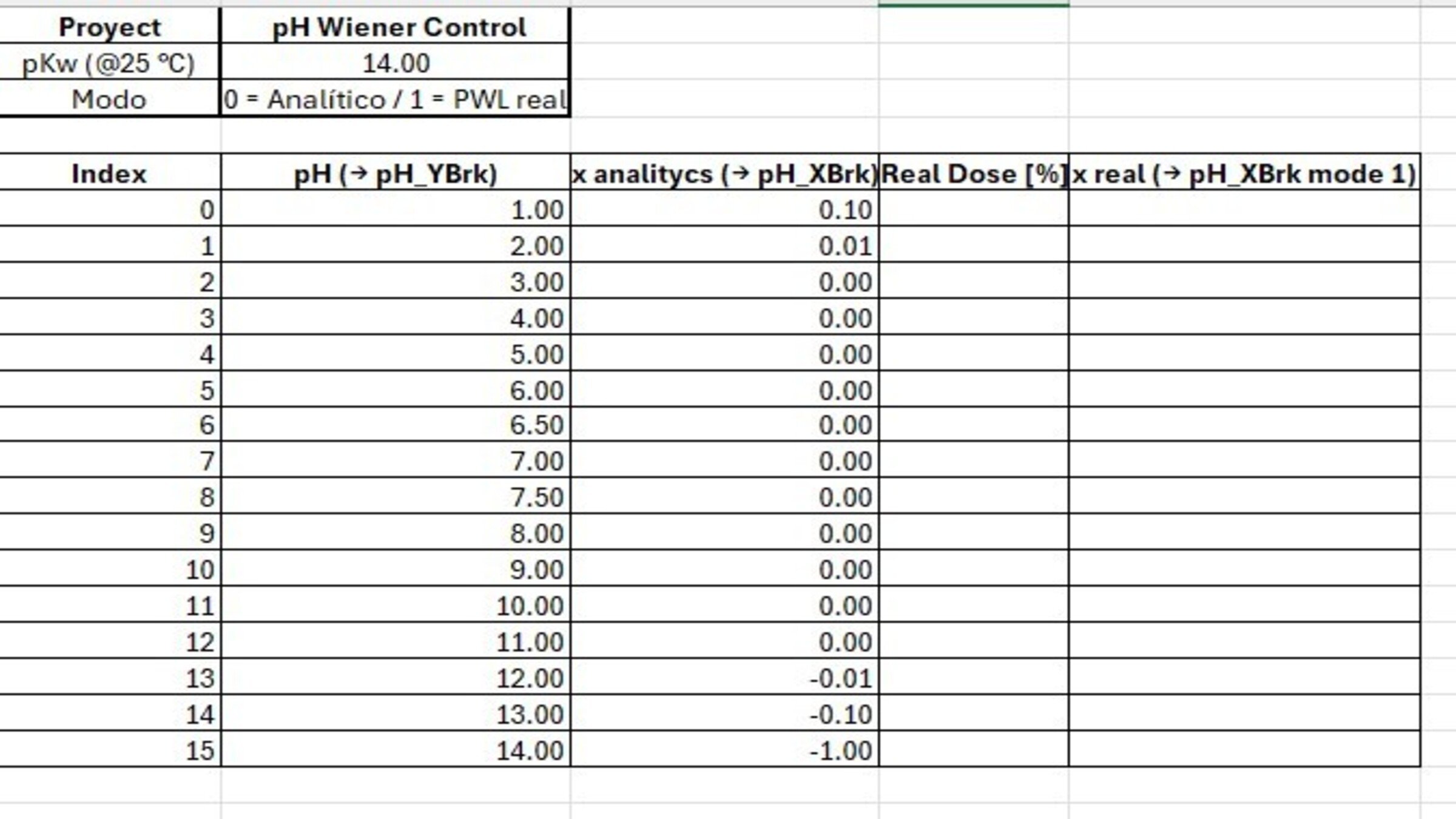
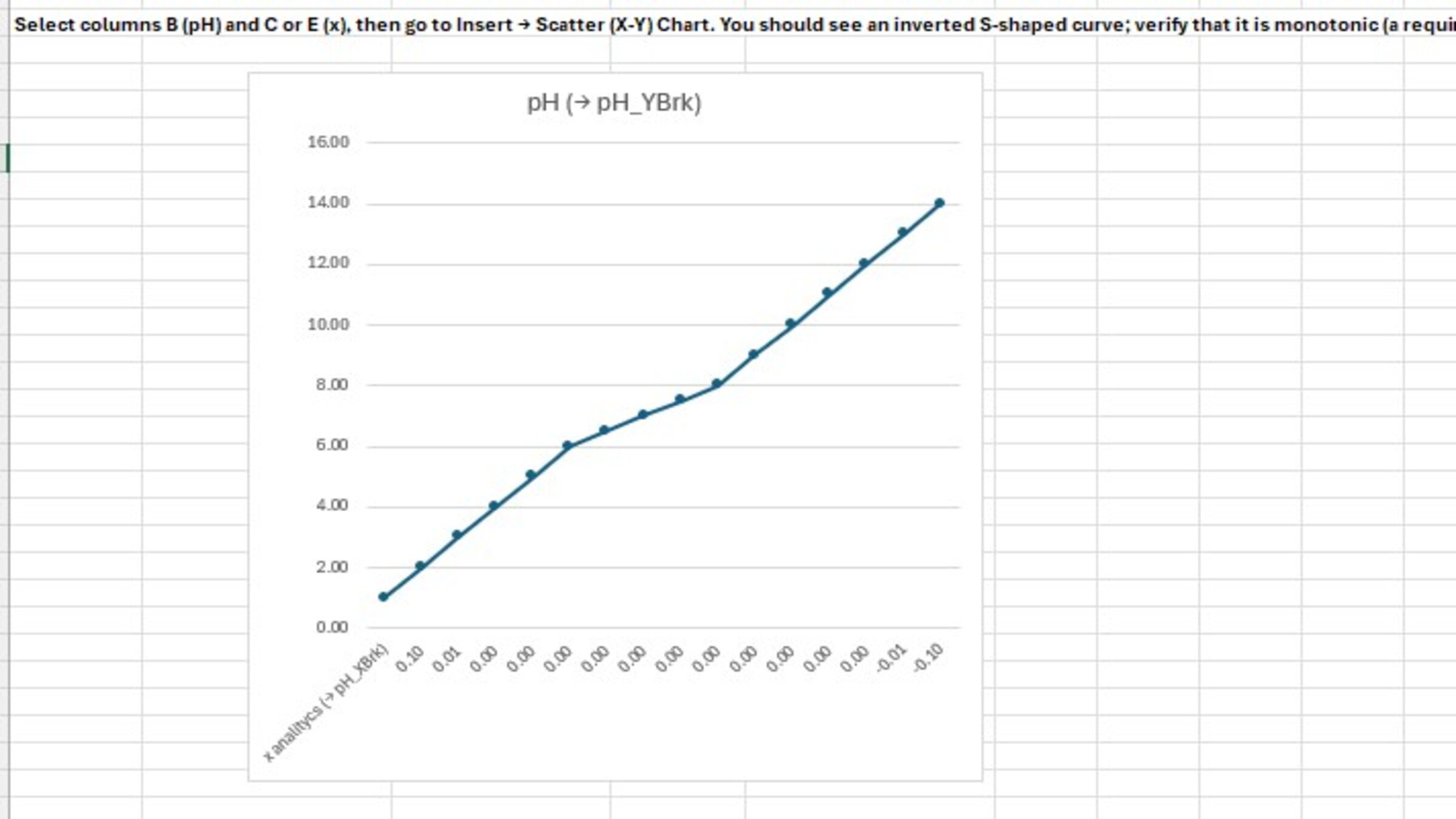
Populate the titration curve (pH_XBrk / pH_YBrk):

  • In the tag monitor, complete the 16 values of each array (indices 0–15).
  • pH_YBrk: ascending pH (1.0 → 14.0).
  • pH_XBrk: linear domain x values (calculated or from actual titration).
  • Verify that pH_YBrk is strictly ascending and without consecutive repeated values
     
 
control-of-ph-based-on-a-wiener-model_16x9-phControl_step7_imagen1.jpg

control-of-ph-based-on-a-wiener-model_16x9-phControl_step7_imagen1.jpg

Step 8


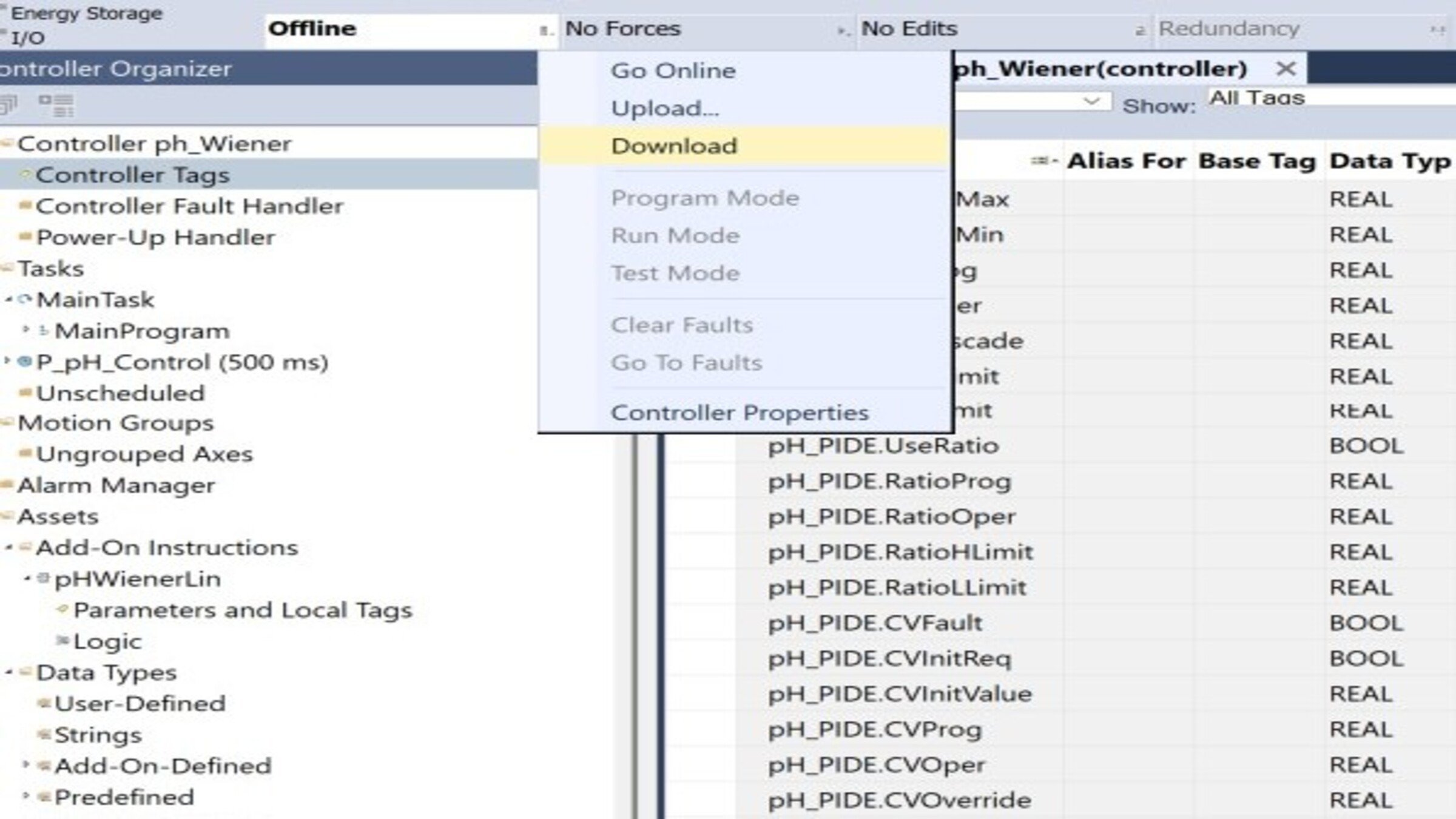
Download the program to the controller:

  • Configure the communication path (RSLinx / FactoryTalk Linx).
  • Verify the project with Verify (Ctrl+K) — it must compile without errors.
  • Download the project and set the controller to Remote Run mode 
 
control-of-ph-based-on-a-wiener-model_16x9-phControl_step8_imagen1.jpg

control-of-ph-based-on-a-wiener-model_16x9-phControl_step8_imagen1.jpg

Step 9


Test in Manual mode

  • Set the PIDE to Manual from the pH_PIDE tag.
  • Verify that when varying pH_PV (or forcing values in simulation), Out_PVlin changes sign when crossing pH 7 (positive in the acid zone, ~0 in neutral, negative in basic).
  • Confirm Sts_Linealizado = 1 and that pH_CVout responds manually. 
 
control-of-ph-based-on-a-wiener-model_16x9-phControl_step9_imagen1.jpg

control-of-ph-based-on-a-wiener-model_16x9-phControl_step9_imagen1.jpg

Step 10


Tune and test in Automatic

  • With the PIDE in Manual, use the built-in open-loop autotuner (applies a step in CV and estimates the process model).
  • Apply the suggested gains (start with a slow/medium response, suitable for pH).
  • Switch to Auto and validate with small SP steps


Step 11


Validation across the pH range. Run SP steps in the three zones and confirm homogeneous performance:

Zona test SP What to observe
Acid
3 → 4 Stable response, no oscillation
Neutral
6 → 8 Critical zone — no overshoot despite the high gain
Basic
10 → 11 Consistency with the other zones


  • Operation verification (checklist)
  • Project verified without errors (Ctrl+K)
  • pH_PIDE with reverse action confirmed
  • Field tags mapped to I/O
  • pH_XBrk / pH_YBrk arrays correctly populated
  • Manual test: linearization and output correct
  • Tuning applied and Auto test satisfactory
  • Range validation (acid/neutral/basic) homogeneous


control-of-ph-based-on-a-wiener-model_16x9-phControl_step11_imagen1.jpg

control-of-ph-based-on-a-wiener-model_16x9-phControl_step11_imagen1.jpg


control-of-ph-based-on-a-wiener-model_16x9-phControl_step1_imagen1.jpg

control-of-ph-based-on-a-wiener-model_16x9-phControl_step1_imagen1.jpg

control-of-ph-based-on-a-wiener-model_16x9-phControl_step1_imagen2.jpg

control-of-ph-based-on-a-wiener-model_16x9-phControl_step1_imagen2.jpg

control-of-ph-based-on-a-wiener-model_16x9-phControl_step2_imagen1.jpg

control-of-ph-based-on-a-wiener-model_16x9-phControl_step2_imagen1.jpg

control-of-ph-based-on-a-wiener-model_16x9-phControl_step3_imagen1.jpg

control-of-ph-based-on-a-wiener-model_16x9-phControl_step3_imagen1.jpg

control-of-ph-based-on-a-wiener-model_16x9-phControl_step4_imagen1.jpg

control-of-ph-based-on-a-wiener-model_16x9-phControl_step4_imagen1.jpg

control-of-ph-based-on-a-wiener-model_16x9-phControl_step5_imagen1.jpg

control-of-ph-based-on-a-wiener-model_16x9-phControl_step5_imagen1.jpg

control-of-ph-based-on-a-wiener-model_16x9-phControl_step6_imagen1.jpg

control-of-ph-based-on-a-wiener-model_16x9-phControl_step6_imagen1.jpg

control-of-ph-based-on-a-wiener-model_16x9-phControl_step7_imagen1.jpg

control-of-ph-based-on-a-wiener-model_16x9-phControl_step7_imagen1.jpg

control-of-ph-based-on-a-wiener-model_16x9-phControl_step8_imagen1.jpg

control-of-ph-based-on-a-wiener-model_16x9-phControl_step8_imagen1.jpg

control-of-ph-based-on-a-wiener-model_16x9-phControl_step9_imagen1.jpg

control-of-ph-based-on-a-wiener-model_16x9-phControl_step9_imagen1.jpg

control-of-ph-based-on-a-wiener-model_16x9-phControl_step11_imagen1.jpg

control-of-ph-based-on-a-wiener-model_16x9-phControl_step11_imagen1.jpg


Control of pH Based on a Wiener Model
Version 1.0 - August 2026


AHIC White Logo

Receive new applications and Innovation Center updates directly in your inbox.

Subscribe!
 
  1. Chevron LeftChevron Left Rockwell Automation Home
  2. Chevron LeftChevron Left Sup...
  3. Chevron LeftChevron Left Pro...
  4. Chevron LeftChevron Left Downloads
  5. Chevron LeftChevron Left Innovation Center
  6. Chevron LeftChevron Left Control of pH Based on a Wiener Model

Please update your cookie preferences to continue.
This feature requires cookies to enhance your experience. Please update your preferences to allow for these cookies:
  • Social Media Cookies
  • Functional Cookies
  • Performance Cookies
  • Marketing Cookies
  • All Cookies
You can update your preferences at any time. For more information please see our {0} Privacy Policy
CloseClose