Loading
Blog
Recent ActivityRecent Activity

Edge Computing & Containers Rewrite Productivity

Productivity can double when IT & OT converge. Discover 6 operational benefits when deploying software containers on the Edge

Share This:

LinkedInLinkedIn
XX
FacebookFacebook
PrintPrint
EmailEmail
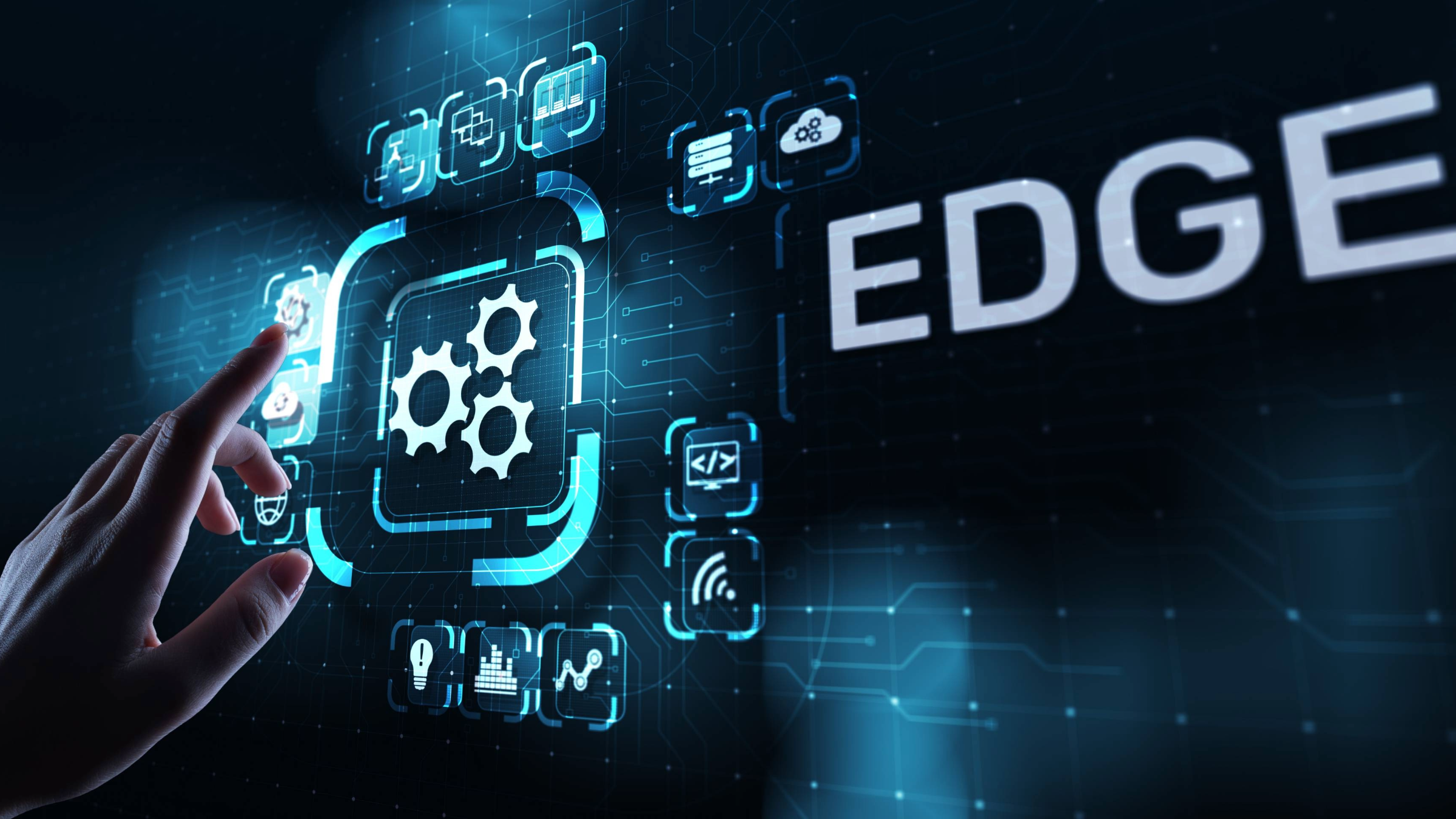
A hand touches a computer monitor interface connecting to edge computing data

Edge computing and containerized software are reshaping industrial automation by processing data at its source and packaging applications into self-contained, portable images.

This combination delivers rapid insights, efficient bandwidth use and consistent IT and OT execution across development and production environments.

Rockwell Automation is translating these benefits into compact, user-friendly edge devices that simplify deployment and management of analytics, control and microservices in industrial control systems.

Edge Computing in Industrial Control Systems

Edge computing refers to a distributed framework that places enterprise applications closer to data sources such as Internet of Things sensors, programmable logic controllers (PLCs) and local servers. This proximity delivers faster insights. Why? Because analytics that execute near the point of data capture improves response times for critical control actions by avoiding wide-area network latency. And it optimizes the bandwidth since only aggregated or filtered data flows to the cloud.

In industrial control system deployments, edge devices can convert raw data into actionable intelligence, filter out noise, run anomaly detection and host dashboards at the machine level. And that real-time data is what engineers, machine operators and product line managers need to boost defect-free output.

Introduction to Containerization: Bridging IT and OT
Blog
Blog
Introduction to Containerization: Bridging IT and OT
The goal of this post is to demonstrate containerization’s power to streamline application deployment across IT and OT environments.
Read Now

Edge Hardware: OptixEdge & Embedded Edge Compute Module

The OptixEdge™ and the Embedded Edge Compute Module share a unified foundation. Both run FactoryTalk® Optix™, support FactoryTalk® Remote Access™ and offer full software container capabilities.

They include the same CPU, RAM and disk specs, and support secure, multi-protocol industrial connectivity (Modbus, EtherNet/IP, OPC UA). This common platform delivers consistent deployment of analytics, microservices, and dashboards across diverse industrial environments.

The Embedded Edge Compute Module is a ControlLogix® chassis-based unit that communicates directly with PLC networks and fieldbus, enabling low latency data exchange and tight integration with PLC logic. It’s ideal for applications that require deterministic control, real-time analytics and autonomous operation within the rack. Engineers can deploy predictive maintenance algorithms, event-based filtering or lightweight OPC UA servers without relying on external interfaces.

The OptixEdge Gateway is a standalone gateway designed for industrial environments. It connects to control systems, executes edge analytics and securely transmits curated insights to cloud platforms. It includes embedded I/O for FactoryTalk® Remote Access™ and a preloaded setup wizard that streamlines Message Queuing Telemetry Transport pipeline configuration from automation devices to cloud platforms.

Plus, its rugged enclosure supports DIN rail or book mount installation, making it suitable for edge analytics, local visualization and secure cloud integration outside the PLC rack.

Containerized software solves IT & OT integration
Blog
Blog
Containerized software solves IT & OT integration
Engineers can bridge IT and OT. Containerized software reduces environment drift and improves consistency from development to production across IT & OT
Read Now

Try FactoryTalk Optix Software for Free

Experience the unlimited options of HMI development in the cloud. Download FactoryTalk Optix Studio Standard for free or get a 90 day trial of FactoryTalk Optix Studio Pro.

A Brief Summary of Containers

Containerized software has powered IT for years, but shifting it to industrial control systems introduces a new set of challenges and benefits. Containers bundle applications along with their libraries, dependencies and configuration into a single image.

This packaging helps guarantee that the same image runs identically on a developer’s laptop, a headless gateway on the shop floor or in the cloud. Not every piece of hardware is able to host containers, as they require a container engine.

Container engines create, manage and run containers without an entire operating system required. However, industrial edge hardware presents constraints such as limited processing power, tight memory budgets, headless operation and strict security requirements.

For a deeper dive into software container fundamentals in operational technology environments, see this post.

Software Container Options for Edge Devices

Out of the box, the Embedded Edge Compute modules and OptixEdge™ gateways come with identical container offerings. These devices can run any number of applications once a relevant container image has been created.

The containerized software is embedded in OptixEdge gateways and Embedded Edge Compute modules:

  • Native Docker runtime: To launch any standard Docker image in seconds
  • Embedded Portainer-CE GUI: To inspect, deploy, and view logs in a web interface
  • Docker Compose support: To define and orchestrate multi-container stacks
  • Dockerfile compatibility: Which grants ability to build custom container images
  • Plus, there is host support for ancillary containers such as Portainer add-ons or Ansible playbooks

This unified toolset allows you to build a container image once, store it in your private or public registry and deploy it across any edge node in your network.

Deployment Workflow

Customers can follow a simple workflow to deploy containers on OptixEdge or Embedded Edge Compute devices:

1. Create a Dockerfile that specifies application code and dependencies

2. Build the container image locally and validate it on a development machine

3. Push the tested image to a secure container registry

4. Use Portainer CE or the Docker CLI on the edge device to pull and run the container

This process minimizes library conflicts, operating system mismatches, and manual installation steps that previously slowed OT deployments.

6 Key Benefits of Software Containers on the Edge

1. Scalability: Orchestration frameworks like Docker Compose enable multi-service stacks to be replicated or scaled out across multiple edge nodes

2. Rapid Deployment: Container images can be instantiated, updated, or rolled back in seconds, minimizing operational downtime

3. Increased Customization: Images are built with exactly the runtime components, libraries, and tools needed, reducing complexity and attack surface

4. Resource Efficiency: Containers consume far less CPU, memory, and storage than other options, making them ideal for resource-constrained edge hardware

5. Enhanced Security: Immutable images and process isolation reduce vulnerabilities and contain any breach within a single container

6. Simplify Management: Centralized registries and image versioning make it easy to distribute, update, and monitor workloads across an entire edge fleet

The Bottom Line

By combining containerized software with purpose-built edge hardware, such as OptixEdge gateways and Embedded Edge Compute modules, your organizations can build faster, smarter, scalable architectures that span from PLC racks to cloud services.

Software containers serve as the link between IT best practices and OT realities, delivering real-time analytics, secure deployments and next-gen automation at the network edge. Interested in implementing this solution? Check out the OptixEdge and Embedded Edge Compute.
Streamline OT with Containerized Software: 5 Ways
Blog
Blog
Streamline OT with Containerized Software: 5 Ways
Containerized software address 5 OT issues – See how it helps provide scalable, secure control that simplifies operations and empowers your team.
Read Now

Published June 3, 2026

Topics: Accelerate Digital Transformation Optimize Production Human Machine Interface Human Machine Interface FactoryTalk Optix FactoryTalk ThinManager

Rylee Domonkos
Rylee Domonkos
Intelligent Devices/Software & Control Leadership Development Program Associate, Rockwell Automation
Rylee is a Leadership Development Program associate currently working in business strategy and product management at Rockwell Automation. Rylee is focused on the adoption of containerized solutions in Industrial Control Systems, simplifying product deployment and enhancing knowledge for OT customers.

You may also be interested in

Loading
Loading
Loading
Loading
  1. Chevron LeftChevron Left Rockwell Automation Home
  2. Chevron LeftChevron Left Com...
  3. Chevron LeftChevron Left News
  4. Chevron LeftChevron Left Blogs
  5. Chevron LeftChevron Left Merge Best IT Practices and OT Realities
Please update your cookie preferences to continue.
This feature requires cookies to enhance your experience. Please update your preferences to allow for these cookies:
  • Social Media Cookies
  • Functional Cookies
  • Performance Cookies
  • Marketing Cookies
  • All Cookies
You can update your preferences at any time. For more information please see our {0} Privacy Policy
CloseClose