Loading
Blog
Recent ActivityRecent Activity

The Broader Benefits of NIS2 Compliance in Life Sciences

Get the cyber basics right and compliance and business improvement become a whole lot easier

Share This:

LinkedInLinkedIn
XX
FacebookFacebook
PrintPrint
EmailEmail
doctor clicks antivirus icon on screen

Most cybersecurity professionals will tell you that it is not a case of “if” you will get hacked, but “when”; and this basic premise underpins much of the rationale behind the EU Commission’s revised Network and Information Systems Directive, commonly known as NIS2.

Just to give you food for thought, the European Union’s statistics and data body, Eurostat, found that in 2023 more than 1 in 5 EU enterprises (21.54%) experienced information and communication technology (ICT) related security incidents leading to consequences such as the unavailability of ICT services, destruction, or corruption of data or disclosure of confidential data.

What is NIS2?

NIS2 Directive is legislation that impacts all entities that operate in the European Union with the goal of enhancing cyber resilience. Member states should have transcribed it into law by October 2024.

It replaces the NIS Directive that was developed in 2016. The biggest changes are the expanded scope and additional requirements developed due to the increase in frequency and impact of cyberattacks against critical infrastructure in recent years.

Transitioning from NIS to NIS2

  Scope Compliance incident reporting sanctions
NIS Targeted Operators of Essential Services (OES) in just a handful of sectors: energy, transport, banking, financial market infrastructures, healthcare, and wastewater management. Outlined basic security measures but lacked specifics. Reporting requirements were vague: any incident that substantially impacts the provision of services. Enforcement was left largely to individual EU member states (leading to inconsistencies)
NIS2

It still covers OES in the original sectors but adds entirely new categories:

  • Essential Entities:
    Providers in critical sectors like energy, transport, health, water & wastewater.
  • Important Entities:
    Manufacturing, food production & distribution, chemical production and digital providers.

Supply chain security, requiring organizations to consider the risks posed by entities' suppliers

Mandates a set of minimum cybersecurity requirements that all entities must implement. This includes risk management, incident response plans, supply chain security, and vulnerability reporting.

Mandates a set of minimum cybersecurity requirements that all entities must implement.

Organizations should have an established process to deliver proper reporting to authorities: 

  • Send an early warning within 24 hours
  • Complete an initial assessment within 72 hours
  • Prepare a final, detailed report, not later than 1 month after your initial assessment

Provides for stronger enforcement mechanisms with harmonized rules across all member states. This includes stricter penalties for non-compliance.

  • Essential Entities:
    10M€ or 2% of the global annual revenue
  • Important Entities:
    7M€ or 1.4% of the annual global revenue

Allows member states to hold management of organizations personally liable in cases of proven gross negligence related to a cyber incident.

What are the NIS2 Compliance Requirements?

NIS2 establishes a comprehensive framework of security obligations that range from risk management policies to technical controls like multi-factor authentication and supply chain oversight.

NIS2 compliance requirements
What are the security obligations of NIS2?

Policies and Procedures Policies on risk analysis and information security
Incident handling Incident handling (prevention, detection, and response to incidents)
Crisis management Crisis management and business continuity, such as backup and recovery management
Supply chain security Supply chain security for relationships between each entity and its suppliers or service providers
Security in Network Information systems acquisition, development, incl. vulnerability handling/disclosures
Risk Management (P&P) Policies and procedures to assess the effectiveness of cybersecurity risk management
Basic cybersecurity hygiene Basic cybersecurity hygiene practices and cybersecurity training
Cryptography, Encryption (P&P) Policies and procedures regarding the use of cryptography and, where appropriate, encryption
Human resources security Human resources security, access control policies, and asset management
Multi-factor authentication Use of multi-factor authentication or continuous authentication solutions

NIS2 and the Pharmaceutical Sector

One industry most impacted by NIS2 is the pharmaceutical sector. Already the subject of myriad legislation across multiple disciplines, NIS2—which labels the pharmaceutical sector as ‘essential’—brings additional operational pressures. Although laudable in their intentions and anticipated results, create significant workload for those in charge of compliance.

But pharmaceutical companies should not see their adherence to the NIS2 directive as a box-ticking exercise. Instead, they should see the deployment of modern digital technology—process hardware and MES solutions—and the road to compliance as a journey of broader operational self-improvement. One that goes far beyond the measures (and their results) prescribed by the legislation.

From the outset, tackling the technological and procedural basics of cybersecurity hygiene will certainly create a solid foundation. It’ll also help strengthen your business and define a more manageable evolutionary roadmap based on proven technology, industry best practice and effective governance.

Why NIS2 Matters for the Pharmaceutical Sector

The cyberthreat landscape is evolving at a prodigious rate and the ‘old methods’ of combatting and dealing with incursions are no longer up to the job. This is precisely why national and international government has stepped in. As focus shifts toward OT-based threats, hackers—including state actors, hacktivists, and gangs—are targeting industrial systems for data, disruption, and profit.

Although NIS2 has good intentions across the board, the industry vertical requirements are not considered. Life sciences business owners and CTOs must not only address these potential supply chain disruptions, but also look at the broader business-facing issues, such as the impact on profitability, customer goodwill, brand reputation, and product/consumer safety.

A growing number of companies are finding it difficult to secure adequate cybersecurity because their current controls fall short of what insurers now expect. When security maturity lags, perceived risk rises and it makes insurance coverage too costly or out of reach. This dynamic is one reason boards have elevated cybersecurity into their top organizational priorities.

Non-compliance will see fines of up to €10,000,000, or at least 2% of the total annual worldwide turnover. Keep in mind, that’s ‘worldwide’, not just European operations. And senior management may also be held personally accountable for any failures in adherence to the new rules.

The Path Toward NIS2 Starts with Basic Cybersecurity Hygiene

Basic cybersecurity hygiene is a vital first step and an essential practice going forward. While the potential of AI and big data is compelling, having a lax foundational security puts you at risk for having your intellectual property and operational data exploited.

Before proceeding, review your organization’s compliance efforts. It’s important to assess security risks based on existing assets, review the capabilities surrounding risk management, incident detection and response, and define responsibilities based on locality or region.

Establishing dedicated OT security policies and procedures is another critical step. These help demonstrate compliance and strengthen overall maturity. Effective policies define:

  • Clear objectives aligned to business priorities
  • Which roles are accountable or own OT security
  • What asset visibility looks like for your organization
  • Rules for authentication and remote access

Tips for Implementing Basic Cybersecurity Hygiene

Based on the extensive experience Rockwell Automation has in helping secure industrial environments, consider implementing the following:

  • Network separation and segmentation: Separating trusted and non-trusted zones within ICS networks makes it harder for threat actors to move laterally.
  • Software patching and program updates: Update all software, firmware, and OS according to your OT policy and procedures—and apply mitigating controls when it’s not possible to update an asset.
  • Device hardening: Minimize entry points for threat actors by disabling device capabilities and implementing the least privilege principle.
  • Employee training: Provide specific training regarding ICS cybersecurity so they maintain and operate with a security-first mindset.
  • Continuous monitoring and incident response: Monitor network traffic for anomalous behavior and make sure that you have an incident response plan in place for breaches.

Developing a Business Case for NIS2

Consider compliance as part of a broader business-improvement project, which is started by tackling the basics. A holistic, multi-dimensional approach will help you develop a strategic roadmap to improving cybersecurity maturity long term. As you develop that approach, consider creating a business case to secure alignment and investment.

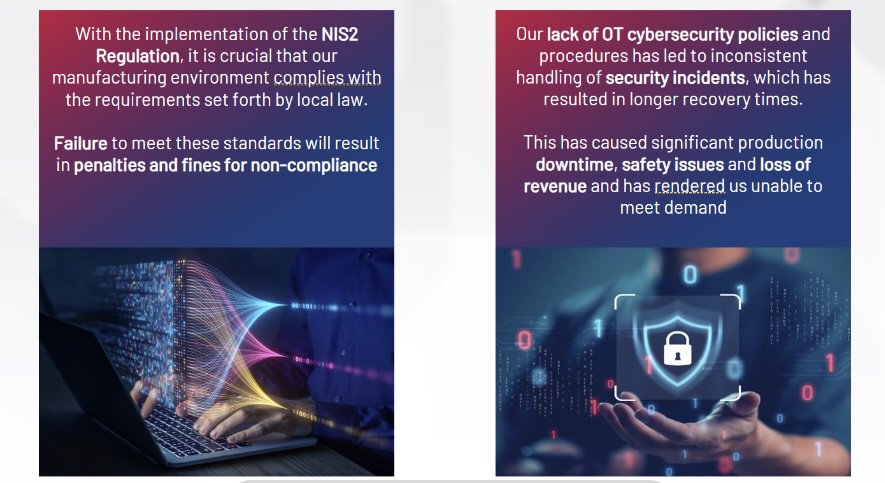
NIS2 Pharma Blog Impact Statement

Figure 1: Example of a problem - impact statement

Here are four things to keep in mind when developing a business case:

  • Set the stage: Identify your problem, create an impact statement, and confirm the organizational outcomes.
  • Gather the evidence: Get the facts so you can confirm your problem.
  • Develop the solutions: Take your risk tolerance, roadmap, regulatory requirements, downtime, costs, and time to implement into account.
  • Outline demonstration results: Solidify what the return on investment looks like, how it’ll be measured, and what the KPIs are.

How Rockwell Automation can help

Minimum Measure Details How Rockwell Automation Can Help
Policies and Procedures Policies on risk analysis and information security Tabletop exercise, Incident Response Plan reviews, OT Risk Assessment, OT Cyber Policy and Procedures
Incident handling Incident handling (prevention, detection, and response to incidents) Network design, Intrusion Detection, End-Point Protection, Incident Response, Crown Jewels Assessment
Crisis management Crisis management and business continuity, such as backup and recovery management Backup and Recovery Services, Incident Response
Supply chain security Supply chain security for relationships between each entity and its suppliers or service providers Network Design and Blueprints, IDMZ
Security in Network Information systems acquisition, development, incl. vulnerability handling/disclosures Network Design, IDMZ, CIP Security, Intrusion Detection, OT Patch Management, Secure Remote Access, Virtualization
Risk Management (P&P) Policies and procedures to assess the effectiveness of cybersecurity risk management OT Risk Assessment, OT Pen Testing, OT Cyber Policy & Procedures Creation & Governance
Basic cybersecurity hygiene Basic cybersecurity hygiene practices and cybersecurity training Asset Inventory, Vulnerability Analysis, Intrusion Detection
Cryptography, Encryption (P&P) Policies and procedures regarding the use of cryptography and, where appropriate, encryption CIP Security, IPSec FactoryTalk® Services, Stratix® Managed Switch Encryption, OPC UA security (FactoryTalk® Linx Gateway, Logix controllers, FactoryTalk® Optix™)
Human resources security Human resources security, access control policies, and asset management PlantPAx®, FactoryTalk® Directory, Asset Inventory, Crown Jewels Assessment, FactoryTalk® AssetCentre
Multi-factor authentication Use of multi-factor authentication or continuous authentication solutions. ThinManager®, FactoryTalk Optix & Secure Remote Access, FactoryTalk® Hub™ & applications, Azure AD authentication, OpenID connect integration FactoryTalk® Security

Figure 2: Solutions from Rockwell Automation that can help organizations achieve minimum measures of NIS2 compliance.

Adhering to the NIS2 directive’s minimum measures requires a mix of robust policy and technical execution. Rockwell Automation, combined with the specialized vulnerability management of SecureOT™ Platform, can provide a comprehensive lifecycle approach to helping secure your OT environment.

Achieving Sustainable NIS2 Compliance with SecureOT Platform

By integrating SecureOT™ Platform, pharmaceutical organizations can strengthen their resilience and help keep operations running. This multi-function platform enables your risk and vulnerability management program by turning OT cyber assessments into measurable risk reduction without the need to increase headcount.

Here’s how SecureOT Platform helps with NIS2 compliance:

  • Fulfill audit requirements: Gain the 360° visibility and asset inventory required by NIS2 hygiene mandates through endpoint architecture that enables targeted, data-driven response.
  • Quicker deployment: Achieve compliance faster by minimizing infrastructure like spans or taps and reduce labor costs.
  • Helps protect critical infrastructure: Adhere to regulatory hardening standards for legacy OS assets through integrated patch configuration and software remediation.
  • Meet reporting mandates: Assist your organization in meeting 24 or 72-hour incident reporting deadlines with 24/7 monitoring and managed security services.

If you want a thorough, pragmatic, and objective opinion of your current state-of-play, we offer a NIS2 Readiness Assessment. Get a clearer view of your cybersecurity posture, prioritize what needs immediate attention, and receive additional support.

Request a NIS2 Consultation

Published June 16, 2026

Topics: Build Resilience Cybersecurity Life Sciences

Abdul Azam
Abdul Azam
Cybersecurity Sales Executive, Rockwell Automation

You may also be interested in

Loading
Loading
Loading
Loading
  1. Chevron LeftChevron Left Rockwell Automation Home
  2. Chevron LeftChevron Left Com...
  3. Chevron LeftChevron Left News
  4. Chevron LeftChevron Left Blogs
  5. Chevron LeftChevron Left The Benefits of NIS2 Compliance in Life Sciences
Please update your cookie preferences to continue.
This feature requires cookies to enhance your experience. Please update your preferences to allow for these cookies:
  • Social Media Cookies
  • Functional Cookies
  • Performance Cookies
  • Marketing Cookies
  • All Cookies
You can update your preferences at any time. For more information please see our {0} Privacy Policy
CloseClose