
Alarm Set Operation (ASO)
The Alarm Set Operation (ASO) instruction issues a specified operation to all alarm
conditions of the specified alarm set. The Alarm Set Operation instruction is used to initiate
asynchronous execution of an alarm operation for all alarm conditions of the specified alarm
set. The instruction iterates through alarm conditions of the specified alarm set and sets an
internal flag requesting the operation execution for each of the conditions. The internal
flags have the same purpose and priority as the existing user accessible Progxxx bits and will
be processed for all the alarm conditions of the specified alarm set during the next periodic
evaluation of each particular alarm condition from the set.
Available Languages
Ladder Diagram
Function Block Diagram
This instruction is not available in Function Block Diagram.
Structured Text
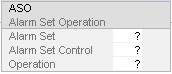
ASO (Alarm Set, Alarm Set Control, Operation)Operands
IMPORTANT:
Unexpected operation may occur if:
- The same tag (ALARM_SET_CONTROL) is used as a parameter for more than one instruction invocation.
- The .LastState structure member is modified by a user application program.
WARNING:
The Alarm Set Control structure contains internal
state information.
WARNING:
If changing instruction configuration operands while in Run mode, accept the pending
edits and do one of the following for the changes to take effect:
- Change the controller mode to Program and then back to Run.
- Change the rung in condition to false and then back to true.
Either of these actions will reset the instruction state machine and turn off all
instruction outputs. Manual restarts may be required after this modification,
depending on the application logic.
The following table provides operands used for configuring the instruction.
Operand | Data Type | Format | Description |
|---|---|---|---|
Alarm Set | ALARM_SET | AlarmSet | The ALARM_SET structure represents alarm conditions that are operated on by this
instruction. |
Alarm Set Control | ALARM_SET_CONTROL | tag | This data type contains three BOOL flags:
The instruction reacts to the edge (transition of .EnableIn from false to true)
instead of the level. EnableOut is always set to .EnableIn. The request to perform the instruction operation have the same priority as ProgXXX
flags. |
Operation | immediate | This operand can be selected from the list or entered as an integer value: 0 - Acknowledge 1 - Reset 2 - Enable 3 - Disable 4- Unshelve 5 - Suppress 6 - Unsuppress 7 - ResetAlarmCount |
Affects Math Status FlagsNoMajor/Minor FaultsNone specific to this instruction. See Index through arrays for
array-indexing faults.
Execution
Condition/State | Action Taken |
|---|---|
Prescan | The instruction clears all ALARM_SET structure members. |
Rung-condition -in is false | The instruction clears .EnableOut and .LastState structure members. |
Rung-condition-in is true | If .LastState is false then the instruction initiates the operation and sets
.LastState structure member to true. The .EnableOut structure member is always set
to true. |
Postscan | The instruction clears all ALARM_SET structure members. |
OperationThe Alarm Set Operation instruction initiates asynchronous execution of one of the
following alarm operations on the specified alarm set:
- Acknowledge
- Reset
- Enable
- Disable
- Unshelve
- Suppress
- Unsuppress
- ResetAlarmCount
The instruction iterates through all alarm conditions which are included in the specified
alarm set or in the nested alarm sets to set an internal flag representing the request to
perform the required operation on a particular alarm condition. The operation is initiated for
all alarm conditions which are iterated by the instruction with the following exceptions:
- Alarm Conditions which are configured not to support alarm operations
- Alarm Conditions which are configured as not used
When an alarm operation is initiated for a particular alarm condition by the instruction, the
operation is performed during the next alarm periodic evaluation of the alarm condition. When
the instruction is called multiple times for the same Alarm Set to initiate contradictory
alarm operations, the last requested operation is always applied to all alarm conditions in
the Alarm Set. The alarm operations initiated for the Alarm Set may be applied to the
conditions before the last requested operation is performed. When an Alarm Condition is
periodically evaluated, the requests to perform particular alarm operations have the same
priority as the requests to perform alarm operations initiated via user accessible Progxxx
flags. It means that if a request to perform an alarm operation is generated by the
instruction, then it is handled as if the corresponding Progxxx flag is set and the same rules
used to resolve conflicting requests specified for ProgXXX flags are used to resolve conflicts
between the instruction requests and requests made via Progxxx flags. The Alarm Set Operation
instruction initiates the required alarm operation only when it detects the transition of
.EnableIn value from false to true. In order to detect the transition, .LastState structure
member is used to store .EnableIn value from the previous instruction execution. See the
Execution section above.
TIP:
If the Alarm set provided as the instruction parameter
contains an excessive number of alarm conditions, then the execution time of the ASO
instruction can increase significantly.
Provide Feedback