“Greater efficiency is also key to our future product and expansion plans. We hear a lot of hype about robotics. But I was really impressed by this system from Vimco and Rockwell Automation. It allows us to combine the quality of craftsmanship with the speed, precision and accuracy of automation.”

Orphea is a brand leader in perfuming, care and protection of fabrics. It specializes in fabric-protection products, including strips and cardboards. The brand develops unique plant-derived active ingredients combined with modern biocidal formulations. These have the benefit of being effective and environmentally friendly. Orphea’s products are household names in Switzerland and are sold across Italy and in other European markets. Orphea is a market leader in European household protection products.

Founded in 1980, Vimco is a leading specialist in the design and manufacture of precision automated packaging systems. The company serves clients across both food and non-food industries, delivering tailored automation solutions to meet different production needs. With a dedicated in-house research and development team, Vimco continuously integrates the latest innovations into the design and construction of its packaging systems — whether standardized or custom-built. From initial consultation and design, through manufacture, installation, and after-sales support, Vimco provides a comprehensive, end-to-end service focused on performance, reliability, and long-term collaboration.
- The production line for Orphea’s perfumed moth-repellent strips had been partly automated. But the final packaging process was still done by hand.
- This introduced higher than acceptable rates of human error and created a bottleneck that caused production difficulties now and hampered future expansion plans.
- The company planned to increase the number of product lines and production volumes. But the manual secondary-packaging processes could not be scaled cost effectively.
- The final packing job required precision, dexterity and intelligence, and the ability to switch between different product and packaging types.
- To overcome these challenges, the company had to find a way to automate the secondary packaging part of the production process.
- Orphea approached Vimco, a specialist in automated secondary packaging systems in carton.
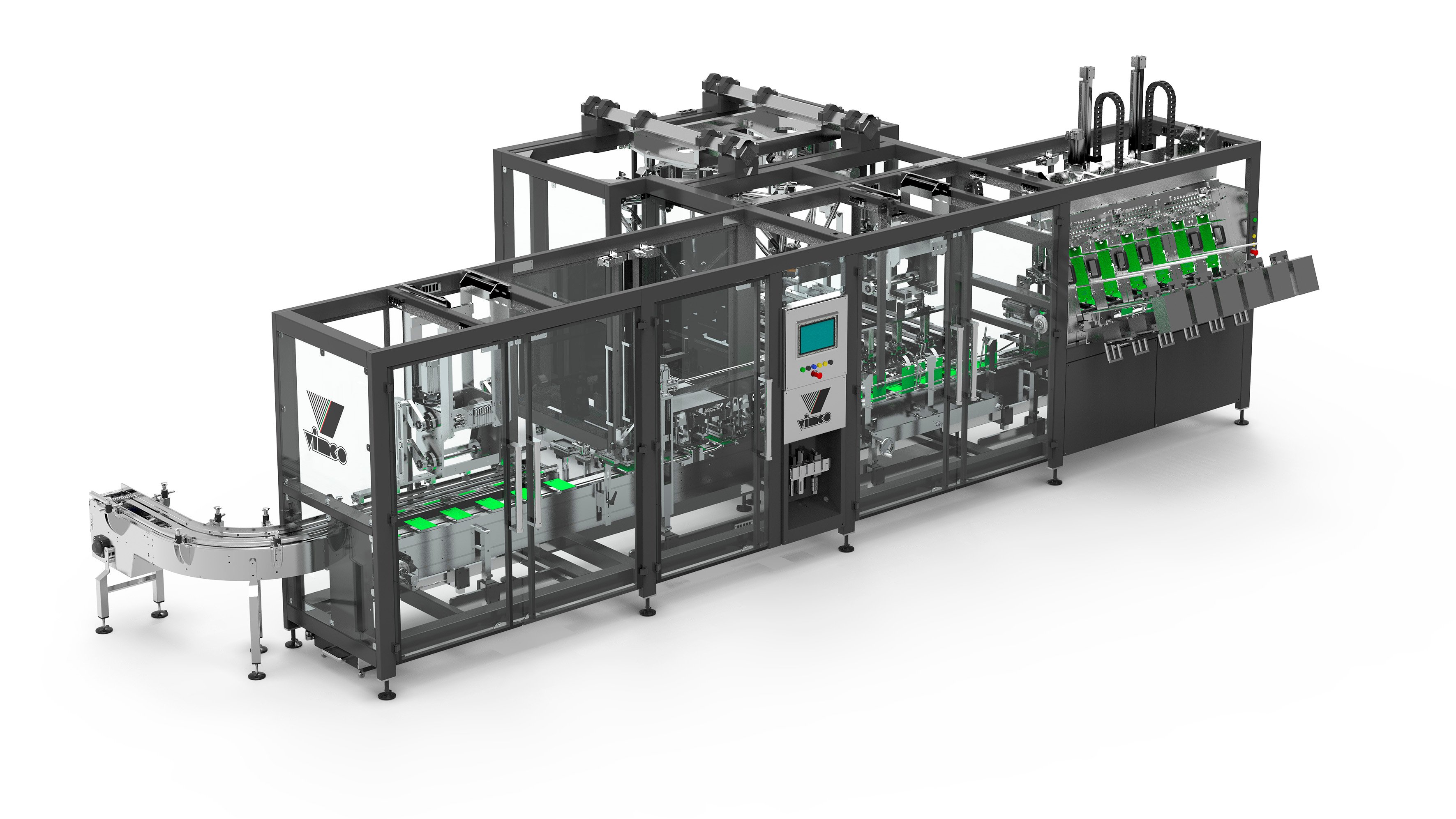
- Working with Orphea’s engineering and production team, Vimco developed and designed a sleeving machine, implementing Rockwell Automation components and latest technologies. This machine is able to package the delicate fabric protection strip.
- The system uses Allen‑Bradley® Stratix® 5200 managed industrial Ethernet switches for secure, deterministic Ethernet networking and Allen‑Bradley® Armor™ PowerFlex® Drives for precision control.
- The two-stage end-of-line platform was designed to handle different product sizes, different packaging sizes and delicate, complex custom-made packaging for a premium product.
- Orphea has been able to merge two production lines into one, thanks to the flexibility and precision operations of the system built using Rockwell Automation technology.
- Thanks to the system’s precision and reliability, Orphea expects to be able to cut error rates and wastage on the automated production lines.
- By automating the final stage of the production line, Orphea has eliminated a significant bottleneck that had previously been a barrier to expansion.
- The increase in productivity enabled by the new system has helped Orphea to upskill workers for higher-value-add roles.
Swiss fabric-protection specialist Orphea produces millions of fabric protectors every year. Sold as individually packaged sheets of paper, these must be handled with care and precision during the manufacturing process – a process originally deemed too complex to be automated.
The fabric protector consists of small delicate sheets of paper, impregnated with a patented formula of perfume and insect repellent. During the production process these sheets are placed in packets, which are then put into shrink-wrapped multi-boxes, ready for palletization.
As part of an ongoing process of automation, Orphea had already modernized and automated the initial stages of the process. However, the final stage of sorting and placing the packets into multi-boxes and then shrink-wrapping the boxes was still being done manually. The persistence of this manual phase slowed the production process down, and made expanding and scaling production difficult.
However, automating this part of the process had proven challenging in the past. The product itself is delicate and needs to be handled with extreme care and precision. The packaging itself was high-quality, branded and designed to be consistent with the quality-perception of the brand. Orphea was clear that it did not want to change the packaging design. So, an automated system had to be able to work with the same design that human workers did, but faster and with fewer errors. It also needed to be able to do it for two different sizes of the Orphea product.
“We needed a serious partner with a credible design and approach to this automation project,” said Andrea Mascetti, production manager at Orphea. “In Vimco, deploying Rockwell Automation technology, that’s exactly what we found.”
“We decided to go with Rockwell Automation because of the complexity required of the machine,” explained Chiara Mambretti, Sales and Market Lead at Vimco.
“We knew we could rely on Rockwell Automation components to give us the precision and interoperability we needed.”
Working closely with Orphea’s product and production teams, Vimco and Rockwell Automation designed a fully automated customized end-of-line packaging system. The system consists of two parts, designed to work in coordination to maintain optimum throughput without any compromise in quality, consistency or reliability.
The first part of the new system places each sheet of fabric-protector into a thin cardboard pouch. The system must be dexterous enough to handle both the delicate fabric protector itself and the thin cardboard packaging. The machine then places each of these thin cardboard packets into boxes.
The second part of the system is an automatic case packer. It takes these boxes and shrink-wraps them in pre-specified quantities, ready for palletization.
As well as increasing throughput and reducing error rates, the new system is also designed to enable rationalization. Using the machine, Orphea can merge two previously separate production lines, each handling a separate size and format of the product, into one. This is possible because Vimco built a fully customized precision solution for Orphea, working closely with Rockwell Automation.
The system consists of a range of complex parts, each of which must work with perfect precision and in harmony with the rest of the production. Components sub-systems included a vision system, to detect the presence, position and size of the product; the robotic picking and packaging system to grasp each element and place it in the appropriate package; and the sleeving system to shrink-wrap the boxes.
To ensure optimal performance from the outset, Vimco used Emulate3D™ Digital Twin Software to design the system, optimize it for Orphea’s use case and environment, and to test the motions, controls and coordination of the different components and sub-systems.
For secure, deterministic industrial Ethernet that ensures the synchronization of all components and sub-systems within the platform, Rockwell Automation provided Allen‑Bradley® Stratix® 5200 Managed Switches. For precision motor-control, the company chose Allen‑Bradley® Armor™ PowerFlex® Drives.
Using this end-of-line packaging system, Orphea has been able to merge two production lines into one. At the same time, operators who previously packaged goods manually have been retrained to use the new, intuitive interface for the Vimco system.
As a result of this innovation. Orphea can expand its product portfolio and increase production volumes. In the past, the manual final stage of the packaging process would have been a significant bottleneck, slowing down production and making it difficult and expensive to add new product lines or increase production volumes.
Now that the secondary packaging process has been automated, this is no longer the case. The two-stage secondary packaging system works in co-ordination with the entire assembly line, making it easy to accelerate and scale as required. The combination of a vision system, and the ability to sense product size, makes it easy to dynamically switch between product lines and packaging sizes without any loss of accuracy or throughput.
At the same time, the precision system has also led to a reduction in error rates, helping to reduce wastage and rework. This has significant benefits for both cost effectiveness and throughput. The fewer errors there are, the more viable units per hour the factory can produce, and the faster orders can be fulfilled.
“With this new automated system, we can control production cost, speed and quality in a way that enables us to expand, scale and diversify,” said Orphea CEO Gianpaolo Re.
“Our employees now have more skilled, high-value-add work and can be more productive. For us, that means we can keep production in Switzerland, something we are committed to, and remain competitive.”
Published March 26, 2026
You may also be interested in