You may also be interested in


A North Sea offshore platform operating in a space-constrained environment required reliable safety systems to maintain continuous production and protect operational integrity.
- Aging fire and gas safety system components with high failure rates
- Limited cabinet space for new hardware installation
- Need for integration with existing Emergency Shutdown System (ESD) and matrix systems
- Risks associated with legacy wiring and infrastructure
- Need for modernization without interrupting offshore production
- Modernization strategy using Rockwell Automation safety system expertise
- Replaced obsolete I/O components while retaining critical infrastructure
- Pre-assembled, factory-tested systems to reduce installation time
- Phased upgrade options aligned to operational needs
- Continuous operations maintained zero downtime during migration
- Improved system reliability
- Reduced maintenance costs and long-term operational risk
- Full safety compliance through validated system performance
- Scalable, future-ready safety system architecture
Challenge
Aging Safety Infrastructure and Space Constraints
A North Sea offshore oil and gas platform faced increasing challenges with its aging fire and gas safety system. Obsolete components, including I/O subsystems and supporting hardware, were experiencing higher failure rates, increasing maintenance demands and operational risk.
The platform also faced limited physical space within existing control cabinets, making it difficult to install new hardware. Any modernization effort needed to balance system upgrades with strict physical constraints and existing infrastructure limitations.
Complex Integration Without Disruption
The safety system was tightly integrated with other critical systems, including Emergency Shutdown System (ESD) and hardwired matrix panels. Updating one part of the system required careful coordination to maintain safe and reliable operation across all interconnected systems.
Legacy wiring and infrastructure added to the complexity, introducing risks when rerouting or replacing components. The platform also required any upgrade to be completed without interrupting production, making timing, execution, and risk mitigation critical to project success.
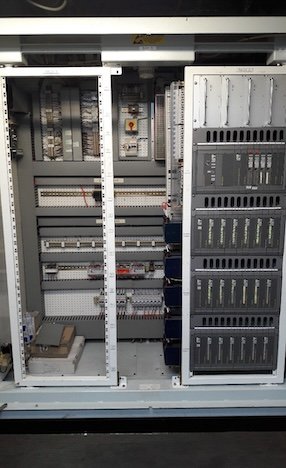
Control cabinet supporting offshore oil and gas safety system, modernized to improve reliability, reduce maintenance, and maintain continuous operations
Solution
Retrofitting Strategy for Modernization
The facility team used a modernization strategy focused on retrofitting existing infrastructure rather than fully replacing it. Obsolete I/O components, power supplies, and supporting hardware were replaced, while controllers and matrix infrastructure were retained to reduce cost and complexity.
This approach allowed the platform to modernize its safety system without requiring extensive redesign or additional space. By leveraging existing equipment when possible, the solution maximized efficiency and minimized disruption.
Efficient Deployment and Flexible Upgrades
To reduce risk and installation time, system assemblies were pre-built and tested before delivery. This supported faster deployment offshore and validation of system performance prior to installation.
The solution also made efficient use of existing mounting structures and wiring, simplifying installation and reducing the need for modifications. Flexible upgrade options were introduced for operator interfaces, allowing the platform to align modernization efforts with operational priorities and budget constraints.
Result
Smooth Modernization and Reliability Gains
The modernization was completed successfully without interrupting offshore operations, maintaining continuous production throughout the upgrade. By replacing obsolete components, the platform significantly improved system reliability and reduced the risk of component failures.
The updated system provided more stable and dependable performance so that safety functions continued to operate in a demanding offshore environment.
Reduced Costs and Future-Ready Systems
Strategic reuse of existing controllers, matrix systems, and infrastructure helped reduce overall project costs while still delivering performance improvements. At the same time, modernized I/O subsystems improved maintainability and reduced long-term service requirements.
The flexible upgrade approach also created a scalable path for future enhancements. With a more standardized and reliable safety system in place, the platform is better positioned to support ongoing operations and future modernization efforts.
Published July 1, 2026