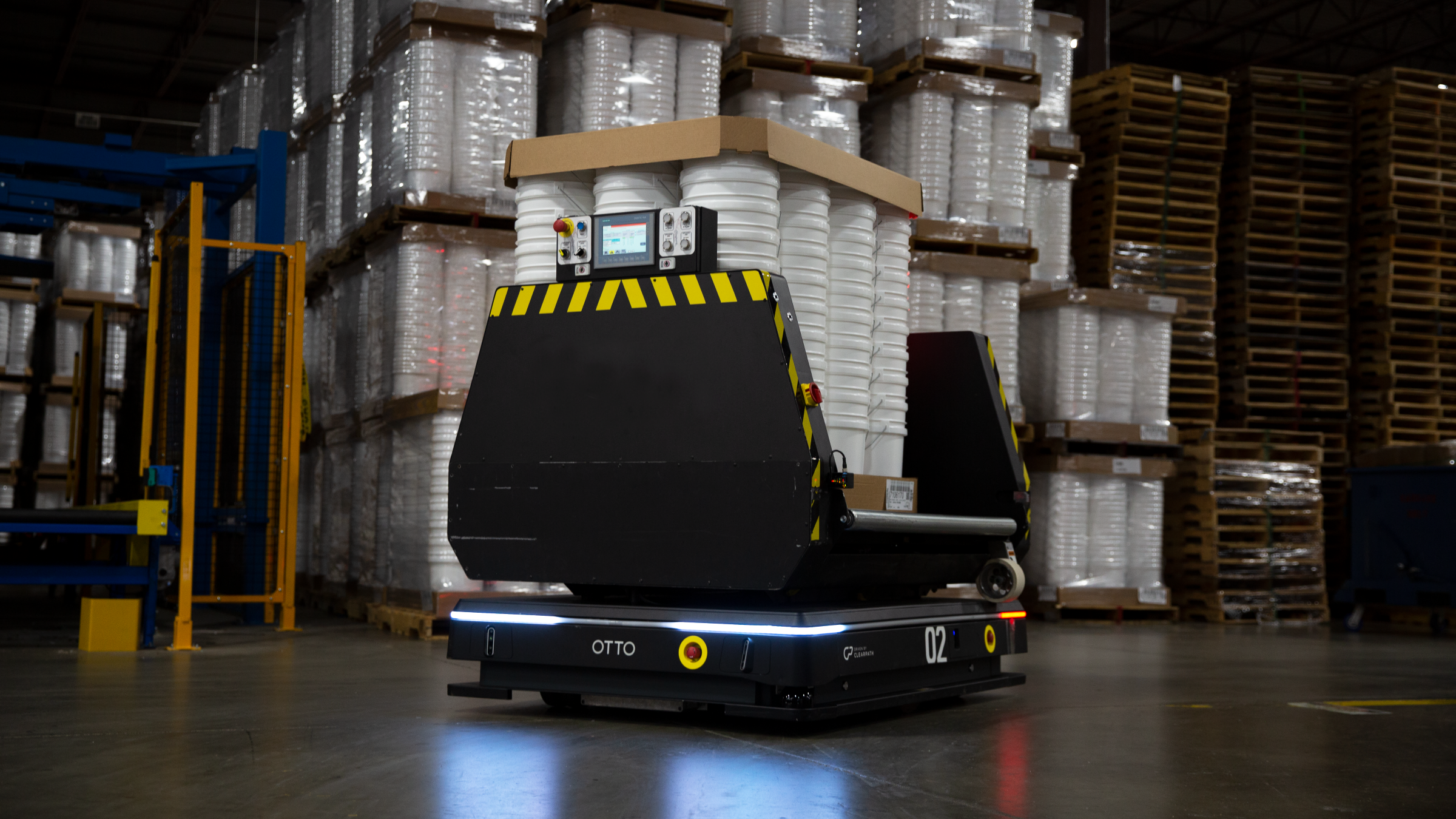
It’s time to modernize material movement. While often overlooked, transitioning from manual to automated material movement drives significant ROI. By adopting autonomous mobile robots (AMRs) and moving from manual, siloed processes to a unified production logistics system, companies can streamline material flow to, between and from manufacturing lines.
Bringing this production logistics vision to life involves integrating AMRs into a fully connected system to enable dock-to-dock autonomous material handling, centralized management of automated processes, and data-driven insights. Connecting hardware and software on a unified platform allows manufacturers to harness data from their entire technology stack—unlocking efficiency gains, cost savings and throughput improvements that lead to greater ROI.
Boost efficiency and minimize footprint with AMRs
An integrated system improves efficiency, as assets like fixed conveyers, forklifts, and AGVs with fixed routes are replaced with agile AMRs. Since AMRs intelligently transport inventory and navigate, they can move material at faster speeds over shorter distances, delivering higher ROI. AMRs also help maximize use of facility space. On average, manual material movement consumes 55% of factory floorspace.1 GE Healthcare reduced the footprint of their repair cells by 40% by adopting AMRs.2 AMRs have tighter turning radiuses compared to forklifts, allowing for narrower aisles, and just-in-time delivery frees up space by reducing the need for staged pallets.
Reduce costs by reallocating labor and improving safety
Modernized material movement also helps reduce labor costs. One report found that AMRs can reduce operational costs by up to 65% by reducing the need for manual labor.3 By implementing AMRs, organizations can distribute their current workforce more strategically by automating repetitive, low-value tasks and reallocating human personnel to higher-value tasks. Enabling workers to do more fulfilling and less physically taxing work also boosts morale, improving retention rates.
AMRs further cut labor costs by reducing workplace injuries caused by heavy lifting and forklift use. Manually driven forklifts are especially accident-prone. On average, 11% of all forklifts are involved in some kind of accident each year.4 And these accidents tend to be more serious, requiring more recovery time on average than other safety incidents.5 With AMRs, organizations can reduce safety risks by eliminating the need for forklift use and manual labor. FORVIA reduced safety incidents to zero in the 11 months after they adopted AMRs.6 AMRs also use safety-rated sensors to monitor the area around them so they can avoid moving objects and take evasive action if their paths do cross, reducing the chance of collisions.
Streamline operations and accelerate project timelines with simulation and emulation technology
Simulation and emulation unlock even more possibilities. With digitized and integrated material movement, operators can use the detailed data collected by the system to run simulations of different possible scenarios to identify opportunities for optimization as well as help anticipate and prevent bottlenecks. Using simulation and emulation technology also accelerates project timelines. One company found that using emulation technology reduced total project time by 18%, including reducing on-site commissioning time by ~5 weeks.7 When all these benefits are combined—visibility, insights, coordination—the result is simple: A more efficient system that provides quantitative data to help companies make smarter decisions, boost throughput and increase revenue.
Increase throughput with optimized scheduling
With a holistic approach, previously siloed processes are coordinated with an optimized production schedule, improving throughput. Overall, integrated production systems achieve an average throughput increase of 13%.8 By incorporating each element of material movement into the production plan and orchestrating the work of human operators, AMRs, and automated guided vehicles (AGVs), each movement can be carefully sequenced to help ensure that the right material is flowing to the right place, at the right time.
Integrated systems also allow for fine-tuning in real-time to further optimize scheduling and drive throughput. Connecting scheduling, machine availability and tooling makes quick adjustments possible, like load balancing between machines to avoid bottlenecks as conditions change. Instead of having dedicated machines per line, imagine being able to distribute the workload between them dynamically, based on real-time conditions like changes in customer demand and resource availability. Integrated systems can also adjust the production plan in real-time so everything shows up when it should, without relying on human intervention to stay on schedule when conditions change.
Production logistics is the next frontier of automation
A holistic approach to material movement provides organizations with an opportunity to gain an edge in today’s manufacturing landscape. Dynamic routing and coordinated processes help operators respond to changing conditions and help ensure that production stays on schedule. The benefits go beyond a reduction in labor costs or injuries, unlocking new revenue by boosting efficiency, freeing up floor space and increasing throughput. With integrated production logistics, organizations can enable a truly connected, coordinated production system across the enterprise.
1 “Proposed improvement of production floor layout using urban algorithm…” U Tarigan et al, 2021 IOP Conference Series: Materials Science and Engineering.
2 GE Healthcare Customer Story, OTTO
3 AGVs, AMRs and picking robots to lead the automated warehouse market, worth $27B by 2025 - Logistics Management
4 Industrial Truck Association statistic
5 5 Common Forklift Accidents and How to Prevent Them - OSHA.com
6 Predictions for 2025 and beyond: AMRs poised for accelerating adoption - Automation Magazine
7 Emulation Technology Speeds Up Warehouse Automation
8 Rockwell Automation internal data