You may also be interested in
PBS Biotech is a biotechnology company dedicated to advancing the manufacture of next-generation cell therapies through innovative bioreactor technologies. Its patented Vertical-Wheel® bioreactor platform delivers gentle, low-shear mixing with scalable performance to support process development, clinical manufacturing, and commercial production. PBS Biotech partners with leading biotechnology companies, CDMOs, and academic institutions worldwide to accelerate the development and commercialization of life-changing cell therapies.
- Industry workflows remained slow due to low-throughput systems
- Developers struggled to scale lab results to commercial manufacturing
- Manual processes increased variability across non-standardized control environments
- Proprietary systems restricted global deployment and scalable standardization
- PlantPAx® with Rockwell Automation Library of Process Objects, and FactoryTalk® software provided precise, repeatable control of key process parameters
- Automation reduced process variability and ensured consistent execution
- Standardized automation platform simplified integration across manufacturing environments
- Connected architecture enabled continuity from development to production
- Accelerated time-to-results through parallel experimentation
- Reduced scale-up risk and created a path to commercial production
- Supported earlier, data-driven manufacturing decisions
- Simplified global deployment with standardized automation
Challenge
PBS Biotech recognized that its customers face mounting pressure to accelerate cell therapy process development while ensuring scalability, reproducibility, and regulatory readiness. Across the industry, low-throughput, iterative workflows slow progress, while challenges in translating lab-scale results to commercial manufacturing introduce risk.
Manual processes and non-standardized environments drive variability and limited continuity from research and development through production. In addition, reliance on proprietary or PC-based systems constrains global deployment, contributing to extended timelines, increased costs, and higher risk as therapies advance toward commercialization.
To help its customers overcome these barriers, PBS Biotech partnered with Rockwell Automation to embed standardized, globally recognized automation in its MiniPRO platform. PBS and Rockwell were initially connected through their participation in the Advanced Regenerative Manufacturing Institute (ARMI), where collaboration efforts focus on advancing automation to scale cell and gene therapy manufacturing.
Solution
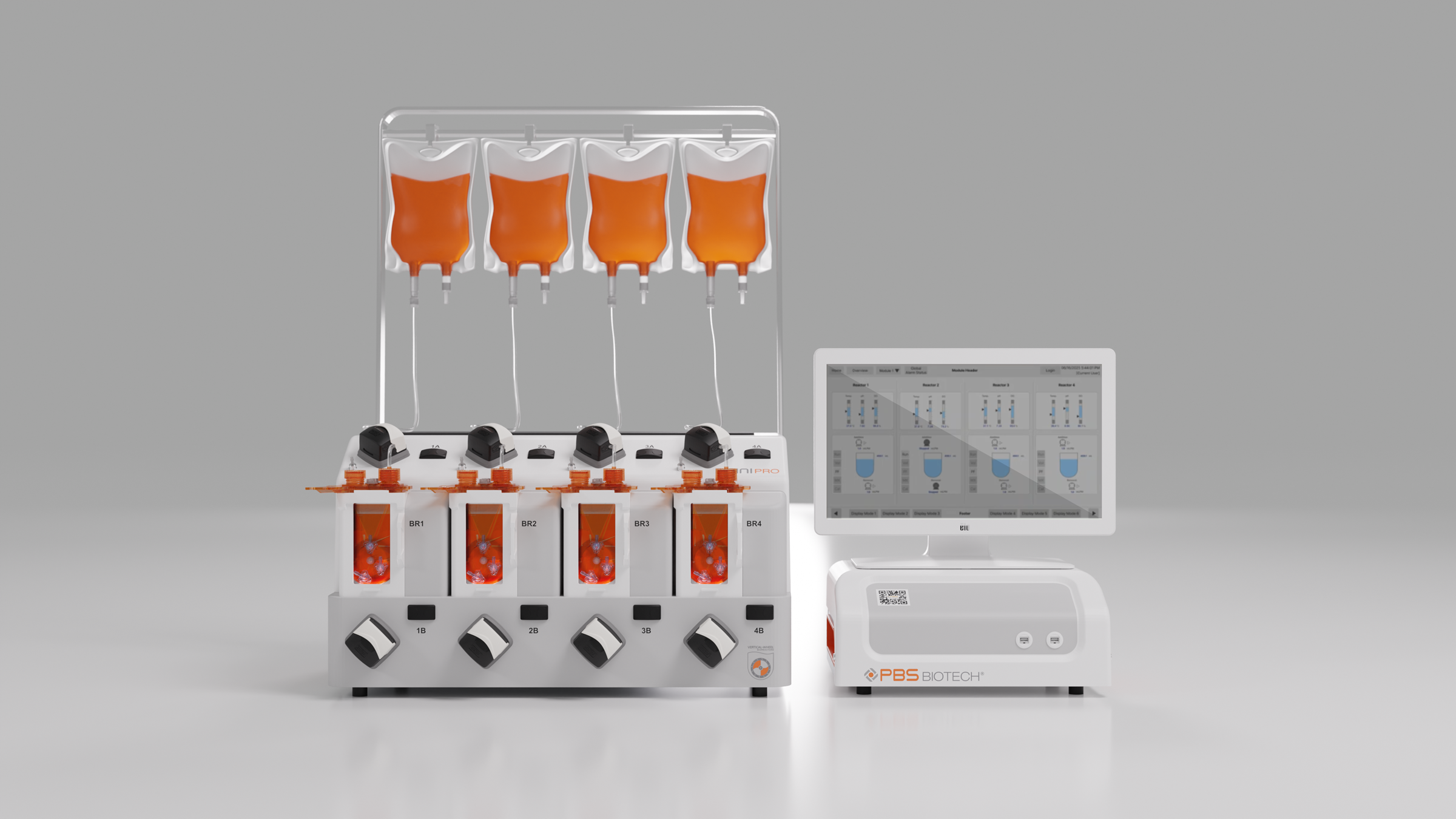
PBS Biotech designed the PBS MiniPRO™ Vertical-Wheel® Bioreactor System to bring industrial rigor to early-stage process development. “The MiniPRO is a closed, automated bioreactor system featuring up to 24 independently controlled bioreactors that enable users to rapidly execute complex process development studies at small scale,” said Sharon Harvey, Director of Product Management and Strategy, PBS Biotech. “It gives product development teams the ability to evaluate multiple conditions at once, accelerating process optimization by helping identify optimal manufacturing conditions faster.”
The platform uses PlantPAx® with Rockwell Automation Library of Process Objects, and FactoryTalk® software to deliver tightly managed, real-time regulation of key process conditions within a scalable automation environment. The configuration-ready solution, which leverages Rockwell's approach to quality within the product development process, enabled PBS to minimize variability and risk with deployment and reduce the time for startup and validation. “When we designed MiniPRO, we wanted to give developers more than just another benchtop bioreactor,” said Harvey. “We wanted an automation platform that would enable users to use it not only for process development but take it all the way through manufacturing.”
Independent bioreactor control enables simultaneous evaluation of multiple conditions, accelerating experimental throughput without sacrificing control fidelity. Structured workflows standardize execution across runs, reducing variability introduced during early development. The architecture aligns with widely adopted industry standards, easing integration into existing facilities.
“MiniPRO serves as a predictive scale-down model of our larger Vertical-Wheel bioreactors,” said Harvey. “We’ve demonstrated that overall process performance remains consistent with our larger-scale bioreactors. That’s key because it allows developers to generate data that is relevant to manufacturing scale, but in a much smaller, more cost-effective format.”
The MiniPRO helps ensure continuity of process information as cell therapy development progresses, supporting a more consistent transition from development through commercial manufacturing.
Result
The MiniPRO™ platform accelerates cell therapy development by bringing closed-system process control into the early development phase. Standardized execution improves process reliability while reducing variability and risk across runs.
“Rockwell technologies let us provide industrial-grade control of critical process parameters, so users are generating high-quality process data in an environment that looks and feels like commercial manufacturing,” said Harvey. “That’s really advantageous because developers are able to introduce this during the product development stage and then evolve towards clinical and commercial manufacturing with history and control.”
ARMI was an early adopter of the PBS MiniPRO. “Typically you don't see this control in a system as small as the MiniPRO,” said Tom Bollenbach, Chief Technology Officer at ARMI. ”With our first integrated manufacturing line, our biggest challenge was getting the process control system to sequentially hand off between subsystems. Because the MiniPRO has Rockwell controls, system integration is streamlined. When we talk to the supervisory system that makes hand-offs happen, it's very easy to get them to talk to each other. That enables us to build bigger manufacturing lines.”
As cell therapy development programs progress, stronger alignment between development outputs and manufacturing requirements minimizes risks during scale-up. Adoption is further supported by compatibility with widely used automation environments, while consistent performance across scales enables more predictable transfer into GMP manufacturing settings.
“We knew from the start that Rockwell is a globally recognized automation leader, and many of our customers already utilize Rockwell technologies in their manufacturing operations,” said Harvey.
“By leveraging an already widely-used automation platform, users can adopt MiniPRO with confidence. Partnering with Rockwell is supporting our vision of creating a more connected digital ecosystem where process data generated during development ultimately supports future manufacturing and scale-up activities.”
Sharon Harvey - Director of Product Management and Strategy, PBS Biotech
Published September 30, 2026