
Library objects
A library object is the class definition of an object, it can contain links to other libraries. A library object is instantiated. When instantiating a library, all the linked libraries can be instantiated to new objects, or can continue to link to an existing instantiated object in the library.
Individual library object files (HSL4) are XML-formatted and registered in the ACM
database. A library object typically defines parameters, subclasses, user interface
contents, and portions of controller code, (for example, Logix) and HMI code, (for example,
FactoryTalk View
SE/ME).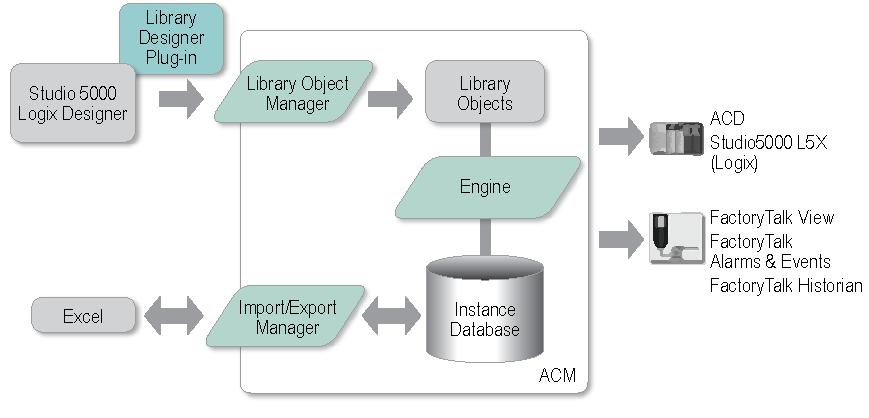
Library objects contain controller code, as well as decoration. Decoration is a set of custom properties applied to a library object using the
Library Designer
. Decoration can be inherited from a library object that is higher in scope such as the Controller and Project object. Decoration that is applied to a library object is inherited by, or available to, all elements that are contained within the library object. Decoration can also be applied directly to an element, overriding inheritance from the library object and from library objects of higher scope.ACM provides the option to include Project Data during the controller code generation. If this option is selected all instances with their parameter values, as well as all libraries (zipped) will be included as part of the Controller's Custom Properties.
Every element created and included by ACM will also have project data custom properties that include information about the instance and the library that owns or created the element.
Provide Feedback