
Loading
Magazine

How Automation Led to New Business Model for Panel Shop

Using new technology for cutting and wiring its custom enclosures helped this company change workflows and boost quality and turnaround time.

Share This:

LinkedInLinkedIn
XX
FacebookFacebook
PrintPrint
EmailEmail
How Automation Led to New Business Model for Panel Shop hero image

Editor's Note: This article is adapted from “Automation Leads to New Business Model for Panel Shop: A Study in Competitive Manufacturing,” a technology examination and end-user case study from Rockwell Automation EncompassTM Product Partner Pentair - Hoffman. Download the free, full analysis to learn more details about panel shop PTS Products, how changing its business model improved quality and service, and how the automated cutting system for enclosures affects labor and productivity and helped PTS Products serve customers.

When PTS Products moved into a larger facility in Maple Plain, Minnesota, during the summer of 2015, management's goals expanded to include higher quality and faster turnarounds for customers. The company is a contract manufacturer of electrical and electronic assemblies for OEMs and end users. The company's new space was crucial to its optimization, allowing the panel shop to change its workflows, add more quality checks and increase throughput.

Its transformation also led to a modified business model. Part of founder Paul Soberg's vision was continually improving to offer new solutions and services; the upgraded space helped make this possible.

“Our core competency is enclosure and panel building,” Soberg explains. This entails panel design, programmable logic controller (PLC) and motion control programming, cable harnessing, and printed circuit-board assembly. By expanding the business, he has been able to take on more customers and even provide services to other panel shops. He has also been able to advance his business by adopting new technologies for modifying and wiring panels, as well as going paperless by storing all information digitally.

New Workflow Builds on Employees' Specialties

The new procedures and workflows start when a customer hands off a design to the shop. “Previously, one employee in a work cell would build a control enclosure from start to finish,” Paul explains. “Now, the design comes into a central area where it's kitted with all of the components, and then it moves to different areas of the shop for different steps in production.”

The new workflow lets employees work at their specialties — machine operators make cutouts for components, and wiring experts wire the components together. Special activities such as making printed circuit boards and engineering have dedicated areas — a new cleanroom for the former and uncluttered workspaces for the latter. Engineers can design systems such as a conveyor belt or program PLCs with less noise and fewer distractions.
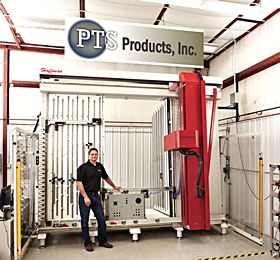
Paul Soberg, founder of Minnesota-based panel shop PTS Products, modified the company’s business model and achieved higher quality and faster turnarounds for customers by moving into a new, larger space and adopting new technologies, including anew automated system for making custom cutouts on its enclosures, the Steinhauer ModCenter from Pentair - Hoffman.

After a panel completes a production phase, it's immediately returned to the central area, where it undergoes an intermediate quality check. Soberg reports that this new workflow has enhanced efficiency and quality significantly.

Automated Cutting and Drilling

One of the largest influences on why PTS invested in a new facility was to accommodate a new automated system for making custom cutouts on the enclosure, the Steinhauer ModCenter. This product comes from the Hoffman-Steinhauer division of Minnesota-based Pentair - Hoffman, a Rockwell Automation Encompass Product Partner. The computer-aided design (CAD) drawing is fed directly into this system, so there's no time dedicated to marking the placements on the enclosure by hand. The ModCenter automatically converts the CAD data to CNC form, and interprets the data to make the holes and cutouts.

Enclosures that are 30- to 40-in. high can require 200-300 holes to be drilled in the back panel along with multiple larger cutouts on the sides, so all the cutting and drilling could take three to four hours. “Now we can do it in 30 minutes or less. And the holes and cutouts are accurate to within a few thousandths of an inch compared to the hundredths we could do previously."

This agility improvement allowed the shop to satisfy one customer in particular that needed an extremely quick turnaround time. This was a request that PTS would be unable to process prior, but continuous improvement and the ModCenter made this project a possibility.

“We got the order on a Monday and finished the three panels on Thursday,” Soberg says. “Previously, this job would have taken two to three weeks by the time we got all the design work, cutting and wiring done.” This was not a typical order, because PTS Products created the CAD drawing with the electrical schematics and placement of components on the panel, rather than the customer providing it.

“We assigned four employees to the project and multitasked,” he explains. “We designed the schematic, the layout of components on the panel, and the holes and cutouts for the ModCenter machine all in parallel.” The group also did the cutting and wiring in parallel.

Breaking with Tradition

Modifying enclosures in-house typically is time-consuming for panel shops, according to Rick Maday, global marketing manager at Hoffman-Steinhauer. The ModCenter machine speeds up the process by allowing shops to make better use of existing CAD files to automate the creation of holes and cutouts. To populate a back panel the traditional way, a worker typically would place the components on the panel, mark their drill holes, remove the components, drill and tap the holes and finally replace the components for final mounting. This can take eight hours or more.

“We need to make modifications in-house,” Soberg says. “Almost every enclosure we build requires some modification, and it can take a lot of time. Reducing the turnaround time has been huge. Making the holes and cutouts automatically has increased our overall productivity by 30 to 40%.”

Hoffman-Steinhauer now is building an extensive library of Rockwell Automation and Allen-Bradley® parts so ModCenter systems will need only the part number to create holes and cutouts automatically. The list will include PanelViewTM graphics terminals, integrated display computers, PowerFlex® drives, motor control contactors and starters, transformers, circuit breakers, switches and other devices.

Soberg adds that, “Making holes and cutouts were the bottleneck of the whole shop.” The ModCenter machine “changes the workflow,” which was a key to his new business model.

Pentair - Hoffman is a participating Encompass Product Partner in the Rockwell Automation PartnerNetwork™. The company provides safeguarding industrial controls, electrical components, and communications hardware, including a comprehensive range of standard, modified and custom engineered solutions for the energy, industrial, infrastructure, commercial and communications markets.

The Journal From Rockwell Automation and Our PartnerNetwork™ is published by Putman Media, Inc.

Subscribe

Subscribe to Rockwell Automation and receive the latest news, thought leadership and information directly to your inbox.

Subscribe

Recommended For You

Loading
  1. Chevron LeftChevron Left Rockwell Automation Home
  2. Chevron LeftChevron Left Company
  3. Chevron LeftChevron Left News
  4. Chevron LeftChevron Left How Automation Led to New Business Model for Panel Shop
Please update your cookie preferences to continue.
This feature requires cookies to enhance your experience. Please update your preferences to allow for these cookies:
  • Social Media Cookies
  • Functional Cookies
  • Performance Cookies
  • Marketing Cookies
  • All Cookies
You can update your preferences at any time. For more information please see our {0} Privacy Policy
CloseClose