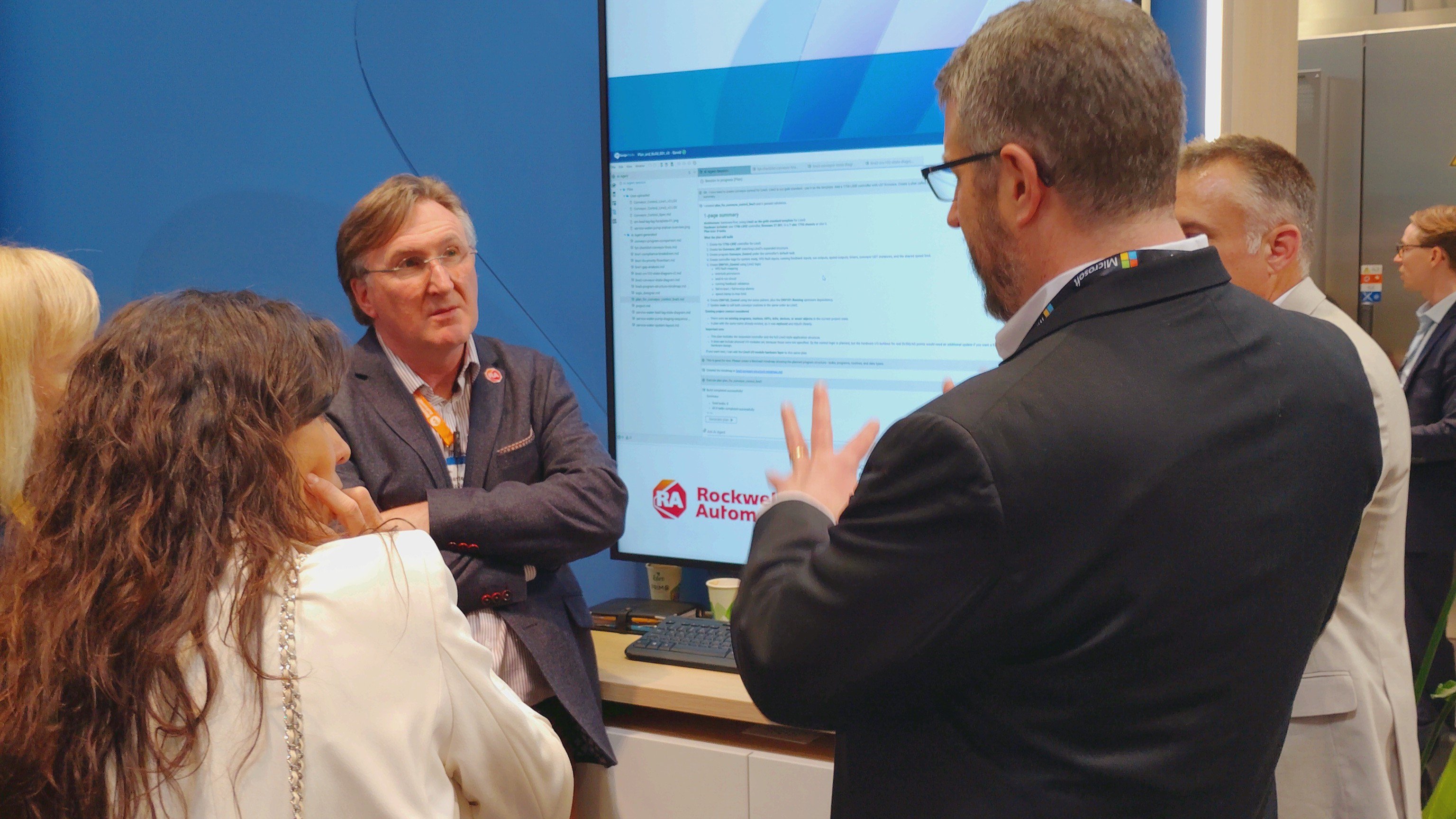
Rockwell Automation, Inc. (NYSE: ROK), the world’s largest company dedicated to industrial automation and digital transformation, will demonstrate a new approach to industrial automation engineering with Microsoft at Hannover Messe 2026, highlighting how AI‑orchestrated system design can reshape the way factories are designed, engineered and deployed. The demonstration will be 20-24 April at the Microsoft booth in Hall 17, Stand G06.
The announcement highlights new agentic, AI native engineering capabilities that connect digital factory design, automation logic generation and performance validation into a single, continuous workflow. These capabilities combine Rockwell’s industrial automation and digital engineering technologies with Microsoft Foundry and Azure OpenAI in Foundry Models, previewing how FactoryTalk® Design Studio™ and Emulate3D® software can work together in a closed loop design environment.
“Manufacturers are under growing pressure to deliver faster, operate more sustainably and adapt continuously to change,” said David Doll, global alliance manager, Rockwell Automation. “By combining our industrial AI and automation expertise with Microsoft Foundry and Azure OpenAI in Foundry Models, we’re showing how AI can orchestrate engineering workflows end to end – from concept and simulation through controller design and validation – enabling manufacturers to unlock value much earlier in the lifecycle.”
Industrial automation engineering has traditionally relied on disconnected tools for simulation, controller programming, testing and commissioning. Even advanced digital twin solutions often stop at visualization and simulation, leaving the transition from model to executable automation code manual, time‑consuming and highly dependent on specialized expertise.
Rockwell Automation is addressing these limitations by enabling three tightly integrated capabilities through its integration with Microsoft. First, manufacturers can generate high fidelity digital twins in Emulate3D software, enriched with agent-based intelligence that understands process intent, system behavior and engineering context.
Second, automation logic can be generated directly within FactoryTalk Design Studio using AI assisted, cloud-based engineering workflows. Third, the digital twin can emulate and execute that automation logic, evaluate system performance and feed results back into the design environment – closing the loop between design, validation and optimization while continuously improving the underlying AI models.
At Hannover Messe, these capabilities are presented through a cloud connected experience that spans Rockwell Automation and Microsoft technologies, demonstrating how engineering data, models and validation insights can persist across tools and stages of the automation lifecycle.
The solution is built on Microsoft Azure in addition to Microsoft Foundry and Azure OpenAI in Foundry Models to connect and deliver AI enabled engineering experiences across Emulate3D digital twin software and the FactoryTalk Design Studio environment.
Together, these capabilities establish a continuous, AI driven engineering workflow that links virtual factory design directly to executable automation logic and validated system performance rather than treating simulation, programming and testing as isolated activities. This approach enables manufacturers to maintain engineering continuity, reduce rework and accelerate decision making well before physical systems are deployed.
Central to the experience is an AI native engineering workflow, expected to be commercially available in May, in which intelligent agents act as active collaborators throughout the design process. Engineers can interact with digital factory models using natural language, explore design alternatives, generate automation logic and validate performance in a closed loop environment that continuously learns from simulation and emulation results before deployment.
By unifying digital twin generation, cloud-based automation design and AI driven validation into a single feedback loop, Rockwell Automation and Microsoft are demonstrating how manufacturers can reduce engineering complexity, shorten commissioning cycles and improve system outcomes with greater confidence and lower risk.
“What we’re introducing is a fundamental shift in how industrial automation projects can be executed,” Doll said. “AI orchestrated engineering enables a continuous flow from digital models to tested automation logic, supported by emulation-based feedback and cloud scale intelligence. This helps manufacturers improve productivity, sustainability and workforce safety while accelerating time to value.”
Attendees at Hannover Messe 2026 are invited to experience these new AI orchestrated factory engineering capabilities at the Microsoft booth and explore how closed loop, agent driven design and validation can support the next generation of smart, autonomous manufacturing systems.