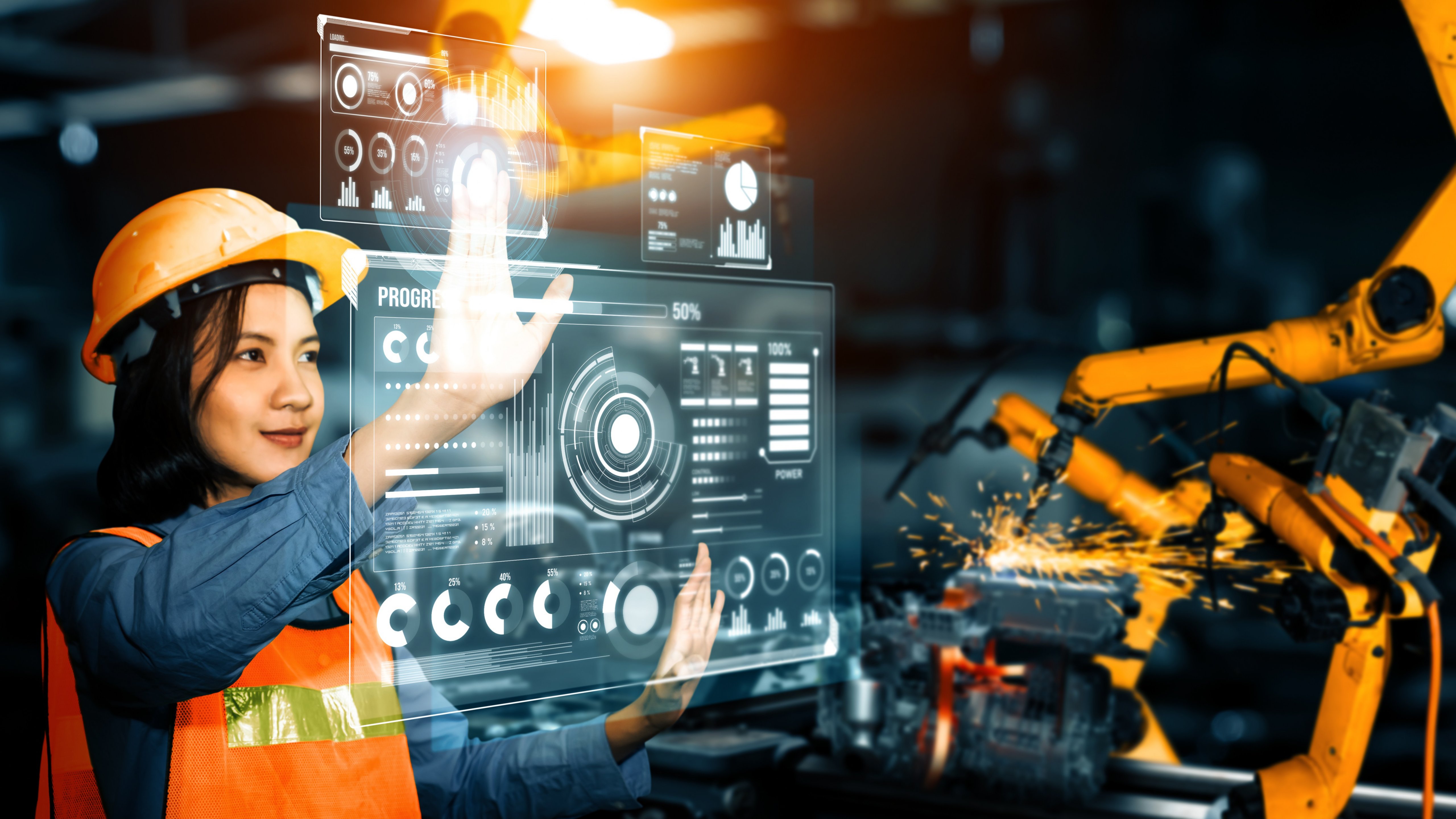
Entering The Execution Era
For years, AI in manufacturing was largely confined to proof‑of‑concepts and closed systems. That phase is now ending, and the shift has been decisive. Manufacturers are quickly moving beyond experimentation and embedding AI directly into operational workflows.
In 2026, more than one third of operations are already augmented with AI, and that figure is expected to surpass 50 percent by the end of the decade.
Organizations that can reliably scale AI across operations and daily decision-making will move beyond fragmented data, siloed systems, and disconnected technologies to help protect against external threats while optimizing their own production processes.
This transition reflects a broader evolution in digital transformation. Manufacturers are no longer asking whether AI works; they are focused on how quickly and consistently it can deliver value.
AI in Action
As manufacturers move from pilot programs to production‑scale deployment, AI is proving its value as part of everyday execution. The State of Smart Manufacturing findings show that leading organizations are applying AI across quality, operations, and risk functions to help teams act faster and with greater confidence.
One example comes from the Eastern Municipal Water District (EMWD), California’s sixth‑largest water agency, which applied AI and machine learning to improve performance in one of wastewater treatment’s most complex and energy‑intensive processes: aeration.
Aeration performance changes constantly as flow rates and ammonia loads fluctuate throughout the day. Traditional, rule‑based control systems struggle to keep pace, requiring frequent manual intervention from operators. Working with Rockwell Automation, EMWD piloted an AI‑enabled control system that continuously monitors operating conditions and automatically adjusts control responses as conditions change. Rather than reacting after performance drifts, the system anticipates demand and optimizes airflow in real time.
The results were immediate and measurable. EMWD reduced airflow to the aeration basin by as much as 31 percent, lowering energy consumption while improving quality and reducing chemical use. Most importantly, the AI solution integrates directly into the existing system, making it repeatable and scalable for future use cases.
Empowering People
Manufacturing operations generate more data than ever before. Sensors, drives, machines, and control systems generate data throughout the production process. And still, the State of Smart Manufacturing report reveals that only 43 percent of collected data is used effectively. To win, we must improve the usability of collected data.
So, how do we close that gap? And how do we deliver the right data to the right people in real time?
Contextualized data, delivered securely to the right people, makes for better, faster decisions. AI becomes a force multiplier on the plant floor, in operations centers, and throughout organizations. Teams can now focus less on interpreting complex data and more time on improving outcomes.
Yet trust is crucial. As manufacturers increasingly rely on AI-driven insights, we need to know that the data and underlying systems are truly reliable so that shared intelligence removes uncertainty.
AI does not replace human decision-making in leading manufacturing organizations, it strengthens it. By pairing expert human judgement with real-time data insights, manufacturers are enabling more agile, informed, and resilient operations.
In the execution era, organizations that treat intelligence as a shared resource have a competitive advantage.
Manufacturing for the Future
The State of Smart Manufacturing Report makes clear that AI has moved into the core of modern manufacturing operations. For leading organizations, AI is built into how decisions are made, how work gets done, and how performance improves over time.
Execution separates impact from ambition, and manufacturers realize the need for connected, interoperable systems to turn data into day-to-day operation capability.
Equally important, AI only delivers results when it supports the people closest to the work. When teams receive timely, contextual information they trust, they act faster and with greater consistency. Problems surface earlier and people move from reactive to proactive.
The execution era rewards manufacturers who treat intelligence as carefully designed, broadly accessible infrastructure, embedded into everyday work. Those companies do not chase AI trends. They put intelligence to work, consistently and at scale.
The findings in this blog are from our 11th annual State of Smart Manufacturing Report. This yearly publication provides benchmark data, best practices, and key insights from manufacturers at all stages of digital transformation worldwide. Please visit rok.auto/sosm to download the full report.