
Loading
Case Study | Automotive & Tire
Recent ActivityRecent Activity

Michelin Gains Single Source of Operational Truth with Tailored Visualization and Data Acquisition

Collaboration between Michelin and Rockwell Automation delivers cloud-based software platform that unifies, contextualizes and displays data from multiple sources in globally standardized machine, workshop, and plant supervision solution

Share This:

LinkedInLinkedIn
XX
FacebookFacebook
PrintPrint
EmailEmail
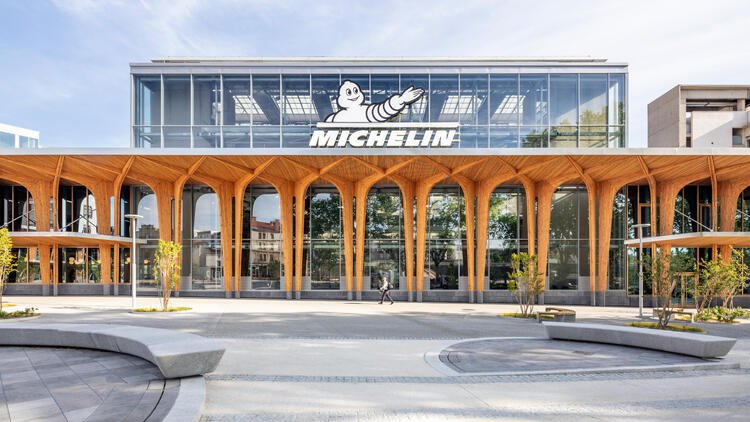
Michelin headquarters
Michelin logo

Pioneering engineered materials for more than 130 years, Michelin is building a world-leading manufacturer of life-changing composites and experiences.

Challenge
  • Multiple locations, all with varying levels and types of technology
  • Different local organic growth patterns and platform deployment
  • No single system to aggregate operational and supervision data
Solution
  • FactoryTalk® Optix™ visualization and data acquisition software
  • Co-development, co-innovation partnership
  • Enhanced visualization, IIoT integration, edge deployment and data management
  • Support from all specialist teams within Rockwell Automation
Result
  • Single source of truth that feeds off multiple disparate data sources
  • Faster, more intuitive insights resulting in lower downtime
  • Native connector to Kafka protocol converging IT and OT systems
  • Tighter integration with enterprise/Oracle solution
  • Scalable platform will simplify global roll out

Challenge

Michelin has always invested in highly capable contemporary manufacturing solutions – to maintain efficiency, boost quality, reduce waste, and keep costs to a minimum. But like many mature companies that have undergone significant organic growth, regular plant investments have led to the deployment of a diverse spread of machines, technologies and services.

All these technologies work together as part of integrated manufacturing plants, but due to their various protocols, architectures, and communication capabilities, managing them all as a homogenous solution is challenging, often relying on multiple HMIs and GUIs, all of which can present similar information, but in very different formats.

“We had a goal to implement a standardized and centralized visualization solution that would make workshop and machine supervision easier and more intuitive for all internal stakeholders, not just the lineside engineers,” explains Xavier Hodasava, standards and IT/OT engineering at Michelin. “The existing machine- and process-visualization solutions in the main control room had their own screens and their own look and feel. There was nothing to merge all this information together, to deliver and contextualize the data into a format that would allow us to more easily and intuitively supervise the complete workshop.

“We needed something that could consume operational data from multiple sources before delivering the right information in the right format to the right people at the right time – not just locally, but at plant and higher levels, too. Of equal importance was its ability to converse seamlessly with our IT solutions, as we converge IT and OT data to provide insights to all elements within the company.”

Solution

To deliver this single source of truth, Michelin worked closely with Rockwell Automation to design, develop and deploy a tailored version of the FactoryTalk® Optix™ visualization and data acquisition software platform – a multi-faceted HMI solution that enhances visualization, IIoT integration, edge deployment, and data management.

An important element of the partnership between the two companies is a formalized co-development and co-innovation agreement. As an early adopter of the new FactoryTalk Optix platform, the Michelin use case and significant input is helping to define elements of its interoperability and developmental roadmap, with the two engineering teams working closely together to standardize the company’s user interfaces and develop a familiar-look-and-feel platform that can be rolled out globally.

A significant outcome of this tight collaboration was the programing of a native connector/driver for Michelin’s Kafka-based communication system. Kafka’s widespread use in the IT sector as a messaging protocol means the driver is essential for seamless communication with Michelin’s IT layer – especially with enterprise packages.

Result

“We set ourselves an ambitious roadmap,” Hodasava explains, “but thanks to great teamwork from both companies, we have seen successful deployment in three plants – two in Spain and one in Italy – all of which can now monitor local in-house developed workshop equipment that use Rockwell Automation control platforms.”

Michelin is also using the FactoryTalk Optix software to monitor other OEM solutions, such as conveyors and AGVs, thanks to OPC UA support and its extensive third-party drivers.

“It’s still early days,” Hodasava continues, “but we are already reacting more quickly to issues that could cause downtime. We can spot anomalies far earlier and, thanks to the more intuitive insights, we can take remedial action faster. These, in turn, result in improved uptime, which is a critical metric in any manufacturing plant.”

Looking ahead, the three factories in the trial exhibit a broad spread of mixing technologies and control platforms, providing a good foundation for further testing and development.

“Our vision is to deploy the FactoryTalk Optix software in all Michelin factories, using the current development efforts we have undertaken for mixing systems as a foundation for a wider global roll out.”

FactoryTalk Optix will be used in assembly and tire-building workshops, where Michelin engineers will be able to adapt it to the specific process needs of each factory, while still maintaining a standardized look and feel.

Michelin’s widespread use of Rockwell Automation solutions has simplified the development and deployment of the FactoryTalk Optix application.

 “This was very important to us,” Hodasava adds, “as global integration was always part of the roadmap, allowing us to take the same tool and supervision processes down to local-HMI level, which would significantly reduce training and simplify deployment. We can also use it as an edge gateway solution, integrated with our enterprise platforms, for data gathering, thanks to its use of smart objects.”

Hodasava talks about his experience collaborating with the Rockwell Automation: “We were all aligned, with the same shared roadmap and goal in mind. From the earliest workshops with ASEM – Rockwell’s specialist industrial computers and monitors division – through to factory roll out, the collaboration has driven the program. Even at this later stage, we are still both working on additional features and ideas in regular workshops, which are also attended by our IT colleagues.”

Published July 1, 2026

Topics: Automotive & Tire FactoryTalk Optix Cloud Manufacturing Software
Subscribe to Rockwell Automation

Receive the latest news, thought leadership and information directly to your inbox.

Subscribe now

You may also be interested in

Loading
Loading
Loading
Loading
  1. Chevron LeftChevron Left Rockwell Automation Home
  2. Chevron LeftChevron Left Com...
  3. Chevron LeftChevron Left News
  4. Chevron LeftChevron Left Case Studies
  5. Chevron LeftChevron Left Michelin Gains a Single Source of Operational Truth
Please update your cookie preferences to continue.
This feature requires cookies to enhance your experience. Please update your preferences to allow for these cookies:
  • Social Media Cookies
  • Functional Cookies
  • Performance Cookies
  • Marketing Cookies
  • All Cookies
You can update your preferences at any time. For more information please see our {0} Privacy Policy
CloseClose