Loading
CASE STUDY | FOOD & BEVERAGE
Recent ActivityRecent Activity

Ken’s Foods Modernizes Palletizing System with Rockwell Automation On-Machine Design

Salad dressing and sauce manufacturer adds flexibility, simplifies maintenance and improves operational visibility

Share This:

LinkedInLinkedIn
XX
FacebookFacebook
PrintPrint
EmailEmail
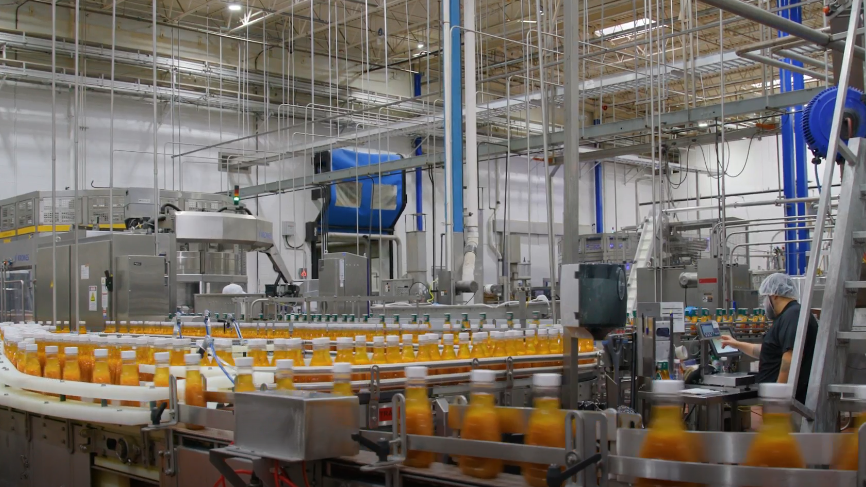
factory production
Ken's Logo

Ken’s Foods is a family business that traces back to 1958 and the basement of Ken’s Steak House, a restaurant in Framingham, Massachusetts that became known for its delicious salad dressings. To this day, Ken’s is still owned by the same family, as they continue their tradition of flavor obsession.

Tony Stolo
Project Engineer, Ken’s Foods
Ethan Jackson
Controls Engineer, Ken’s Foods
Kyle Richard
VP, Business Development, Elm Electrical
Neal Feigles
President, Stokes Material Handling Systems
Challenge
  • Rapid growth across four manufacturing facilities strained existing material handling and palletizing operations, which were no longer aligned with the scale of the business
  • Aging palletizing and conveyor equipment limited operational efficiency and prompted the need for replacement and reconfiguration
  • Traditional cabinet-based VFD architectures required extensive cabling, increasing installation complexity, cost, and commissioning time.
  • Limited data visibility and feedback from the existing system made troubleshooting more difficult and time-consuming.
Solution
  • Armor™ PowerFlex® 350 VFDs
  • PowerFlex® 525 VFDs
  • CompactLogix® PLC Systems
  • PanelView™ HMI Stations
  • Allen-Bradley® Photo-Electronic Sensors
Result
  • Reduced design, build, and install costs by an estimated 17% using On-Machine™ architecture
  • Significantly reduced the amount of cable used and machine footprint in comparison to previous cabinet-based VFD conveyance systems
  • Significantly reduced the amount of cable used
  • Enabled a single person to complete field setup in under two days lowering installation costs
  • Increased production visibility, allowing engineers to view current, voltage, and speed data remotely
  • Created a standard approach for future large and small pallet conveying applications

Ken’s Foods is a leading manufacturer of salad dressings and sauces, operating multiple production facilities across the United States. Continued growth and expansion drove the need for a more scalable, efficient approach to end-of-line packaging and pallet conveying. The customer selected an On-Machine design that integrated Armor PowerFlex 350 drives, CompactLogix 5380 controllers, Allen-Bradley photo eyes and PanelView HMIs. With this approach, Ken’s Foods was able to simplify engineering, accelerate startup, and create a flexible foundation for future growth.

Challenge

A palletizing problem

As Ken’s Foods expanded to four manufacturing sites, its legacy pallet conveying and control architecture no longer aligned with the scale or complexity of operations. Aging equipment, layouts that did not support smooth material flow, and increasing reliance on offsite warehouses introduced inefficiencies that impacted end‑of‑line performance. The company recognized the need to replace and reconfigure pallet conveying systems to better support production and distribution demands.

Traditional cabinet‑based VFD designs also added engineering and installation burden. Panel design and fabrication increased upfront engineering time, while long cable runs for power, I/O, and safety signals added cost and complexity. During commissioning and ongoing maintenance, technicians were required to access remote satellite panels, slowing troubleshooting and limiting flexibility—particularly as safety requirements and conveyor layouts evolved.

Solution

Simpler solution, secret sauce

Working with its material handling and electrical partners, Stokes Material Handling Systems and Elm Electrical, Ken’s Foods deployed a distributed, On‑Machine solution built around Rockwell Automation Armor PowerFlex 350 drives. Because the drives were field‑mounted on the conveyors, the project minimized the need for additional panel engineering. This significantly reduced engineering effort up front and simplified installation, with a single technician able to complete initial setup and configuration of all drives in the field in less than two days.

Premier Integration between the Allen-Bradley devices and controllers further streamlined engineering and commissioning. The Add‑On Profiles provided an intuitive framework for communication, logic development, field I/O, and safety over the network. This approach reduced custom code, simplified drive configuration, and ensured predictable behavior across the system. This ultimately contributed to faster startup and easier long‑term support.

Safety was implemented over the EtherNet/IP network using a Compact GuardLogix® controller and the safety‑rated variant of the Armor PowerFlex 350 drives. The Integrated Safe Torque Off option and onboard safety I/O allowed local E‑Stops to be wired directly into each drive and daisy‑chained over a single network cable, rather than requiring multiple home‑run connections back to a safety panel. This network‑based safety architecture minimized wiring, reduced I/O and panel costs, and provided the flexibility to place E‑Stops virtually anywhere along the conveyors—now and in the future.

“Using the On-Machine VFDs from Rockwell allowed us to deploy a sophisticated safety system over a very large 130 drive palletizing system,” explained Kyle Richard with system integrator Elm Electrical.

Result

Streamlined operational improvements

The distributed architecture delivered significant time savings in engineering, commissioning, and installation. Wiring power, I/O, and safety directly into the Armor PowerFlex 350 drives reduced overall system complexity by removing the need to design and assemble a separate panel. Field setup was faster and more intuitive, and commissioning proceeded without delays related to drive configuration or communication.

“We estimate an overall savings of 17% compared to designing, building centralized panels and wiring directly to local motor disconnects, I/O points and motors.”

Kyle Richard - VP, Business Development, Elm Electrical

Maintenance and operations also benefited from the design. Local disconnects, test points, quick‑disconnect power, and I/O connections simplified lockout/tagout (LOTO) procedures and allowed maintenance teams to isolate equipment locally rather than shutting down large sections of the system. Drives are now accessible directly on the equipment, making troubleshooting and replacements more efficient. Enhanced data visibility—such as real‑time access to current, voltage, and speed—has improved troubleshooting efficiency and made a positive impact on end‑of‑line packaging performance. As a result, Ken’s Foods has adopted this approach as its standard for future pallet conveying applications.

Rockwell Automation is proud to support Ken’s Foods as it modernizes its operations and prepares for continued growth. By leveraging On-Machine design, Ken’s Foods has built a flexible, data-rich, and scalable pallet conveying system suited for today’s demands and tomorrow’s expansion. Together, Rockwell Automation and Ken’s Foods are setting a strong foundation for enterprise-wide operational excellence.

Published July 16, 2026

Topics: Optimize Production Drives Safety Input Output (I O) Modules Industrial Control Products Power Supplies Sensors & Switches
Subscribe to Rockwell Automation

Receive the latest news, thought leadership and information directly to your inbox.

Subscribe now

You may also be interested in

Loading
Loading
Loading
Loading
  1. Chevron LeftChevron Left Rockwell Automation Home
  2. Chevron LeftChevron Left Com...
  3. Chevron LeftChevron Left News
  4. Chevron LeftChevron Left Case Studies
  5. Chevron LeftChevron Left Ken’s Foods Modernizes Palletizing System with Rockwell Automation On-Machine Design
Please update your cookie preferences to continue.
This feature requires cookies to enhance your experience. Please update your preferences to allow for these cookies:
  • Social Media Cookies
  • Functional Cookies
  • Performance Cookies
  • Marketing Cookies
  • All Cookies
You can update your preferences at any time. For more information please see our {0} Privacy Policy
CloseClose