Ironcore and Ironless Linear Servo Motors
A Comparison of Linear Motor and Rotary Servo Motor Systems
Small Motors and Motion Association (SMMA) Fall Technical Conference
"Motion Technology for the New Millennium"
Michael Backman Director, Linear Motor Business Development
Anorad Corporation, A Rockwell Automation Business
Introduction
In today's automated machinery, there are a multitude of linear motion control applications. Whether a simple reciprocating single axis or a more complex rectilinear arrangement of multiple axes producing 2D or 3D motion, system designers have many choices when implementing the actuation of each individual linear axis of motion. Often, conventional rotary motors are chosen to drive some type of rotary – to – linear conversion mechanism which is ultimately connected to the moving payload. A close examination would reveal that rotary – to – linear conversion mechanisms add inertia, friction, compliance, backlash, and wear, all of which compromise overall system performance. Linear motors, on the other hand, offer the system designer an elegant alternative in that they produce linear motion directly and therefore eliminate the need for conversion mechanisms such as leadscrews, belt drives, and rack & pinions. In this discussion we examine the most popular linear motor type – PM synchronous brushless servo – and compare it to its rotary counterpart. We will also analyze key areas in system design required to effectively leverage direct drive linear motor technology.Linear Motor
What is a linear motor
A linear motor can be envisioned as a rotary motor slit axially and unrolled flat (Fig. 1). The same basic technologies used to produce torque in rotary motors are used to produce force in linear motors (e.g. DC brush, induction, PM brushless, PM stepper, switched reluctance, etc.) In industry, the term linear motor typically refers to the primary and secondary electromagnetic sections only and not the requisite system components such as linear bearings, feedback and structure (enclosure). When these other components are included, it is typically referred to as a positioning stage or actuator.Linear Motor Technology Choices
While most any rotary motor technology can be employed in a linear counterpart, Table 1 compares several typical commercial options.
| Type | Force Density | Response | Speed | Magnets | Other |
|---|---|---|---|---|---|
| Induction | moderate | moderate | high | none | heat generation in platen |
| Stepper | low | resonance prone | low | none exposed | open loop capability |
| PMDC Brush | good | excellent | moderate | none exposed | brush wear |
| PM Brushless | excellent | excellent | high | exposed |
Table 1
Induction motors offer high speeds and moderate force density. The fact that they do not use permanent magnets offers potential cost savings in applications where maximum force density is not critical. The lack of magnets is also advantageous when strong exposed magnetic fields can cause problems in certain applications. However, in addition to the stator, induction motors generate heat in the secondary platen (rotor equivalent) portion which can cause thermal dimensional stability problems in precision machinery.Like their rotary counterparts, linear PM stepper motors can operate without feedback, allowing a low cost direct drive system. Although permanent magnets may be used, they are typically not exposed and therefore may provide certain application advantages. However, stepper motors are resonance prone, and suffer from force falloff at high speeds.
PM brush linear motors offer excellent servo performance, good force density,
and a simple two wire connection. Magnets are not exposed. However, the brushes used for commutation limit top speed due to arcing and wear, produce contamination, and require maintenance.
PM Brushless motors offer very high performance capabilities. They have a high force density, low electrical time constant, high maximum speed, and stable force constant. The lack of a brushed commutator assembly eliminates maintenance, particle generation, and increases reliability. With sinusoidal commutation, PM brushless motors have outstanding smoothness.
The main market driver of linear motor technology is the ever increasing performance demand in incremental positioning applications. The digital
revolution has supported this by allowing great advances in motion controller capabilities and reducing the cost of feedback, hence driving system designers
to more often use closed loop control systems. This, in conjunction with advances in magnet materials and power electronics, has caused PM brushless technology to emerge as the dominant type of linear motor. The trend parallels the widespread adoption of high performance rotary PM brushless motor applications
Basic Iron Core
Brushless Motor
Basic Ironless Core
Brushless Motor
Basic Iron Core Brushless Motor
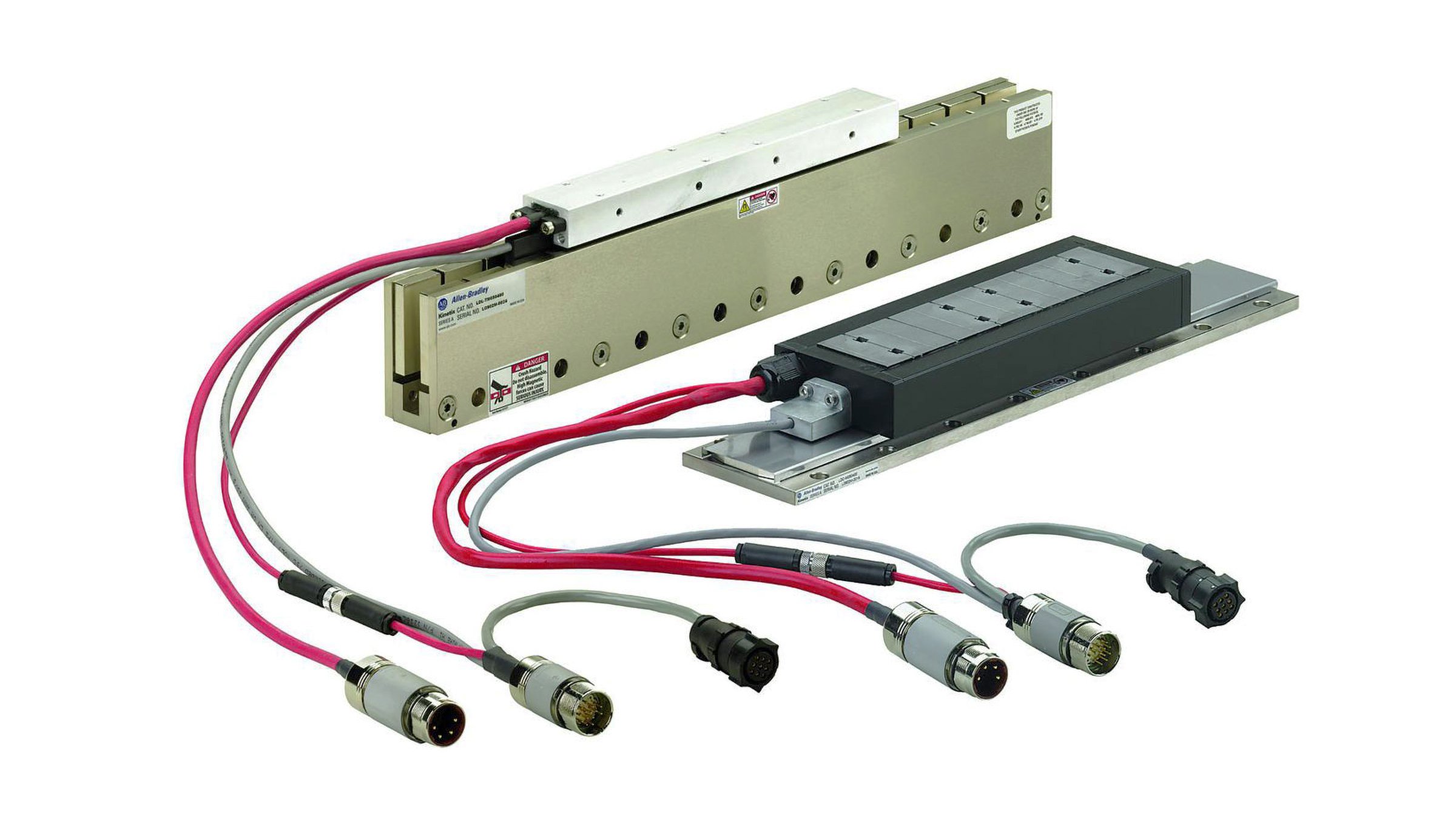
A basic slotted iron core brushless linear motor can be envisioned as a conventional PM brushless rotary motor slit axially and then rolled out flat (Fig. 2). The result is two components – 1) a stationary plate consisting of magnets tiled on an iron back plate (the unrolled rotor); and 2) a moving coil assembly consisting of coils wound around a laminated steel core (the unrolled stator). The system designer must build in a constant air gap (typically 0.030”) along the coil's travel over the magnet assembly. The system's linear guide bearings must withstand the significant magnetic attraction between the two components (3-8 times continuous force). This magnetic attraction is often used as a bearing preload feature. Similar to rotary servo motors, coil windings are typically connected in conventional 3 phase arrangement. Commutation is often performed by Hall effect sensors or software algorithms.Basic Ironless Core Balanced Motor
A basic ironless PM linear motor consists of a stationary U shaped channel containing permanent magnets tiled along both interior walls (Fig. 3). A moving coil assembly traverses between the opposing rows of magnets. A constant air gap (typically 0.030”) must be maintained on both sides of the coil. Unlike the iron core motor, there is no magnetic attraction between the coil and the magnet track as the core contains no iron. Similar to rotary servo motors, coil windings are typically connected in conventional 3 phase arrangement. Commutation is often performed by Hall effect sensors or software algorithms.Iron vs. Ironless Comparison
As when evaluating rotary motors, there is no one best linear motor type. Rather, it's a choice of what's best suited for a particular application. Iron and ironless motors have several distinctly different attributes. Depending on the intended application, these may be advantageous or not. Table 2 compares several of these.
| Iron Core | Ironles | Notes | |
|---|---|---|---|
| Magnetic Attraction | high | none | must be considered as design parameter |
| Cogging (detent force) | some | none | slotless iron core is an alternative |
| Continuous Force Density | highest | moderate | |
| Magnet Exposure | yes | mostly shielded with magnetic field contained | |
| Moving Coil Mass | higher | lower | |
| Stationary Magnet Mass | lower | higher | |
| Pk Force / Coil Mass Ratio | 20 - 30 | 50 - 100 | application load will alter system capabilities |
| Inductance | higher | lower | |
| Eddy / Hysteresis Losses | yes | none | |
| Alignment / Tolerance Requirements | lower | higher |
Table 2
Rotary – Linear Motor Parameter Comparison
Many spec sheet parameters of linear motors are similar to their rotary counterparts (with a conversion of rotary units to linear units). However, some important parameters are different and some are unique to linear motors. Table 3 compares some of the more common parameters.
| Linear | Rotary | Notes |
|---|---|---|
| Force-cont., lb f | Torque-cont, in-lb f | similar thermal limits |
| Force-peak, lb f | Torgue-peak, in-lb f | similar demag and saturation limits |
| Force Constant, lb f /A | Torgue Constant, in-lb f /A | reduced temp sensitivity w/linear due to open design and travel typically being longer than coil length |
| BEMF constant, V/in/sec | BEMF constant, V/krpm | same as above |
| Resistance, ohm Inductance, mH |
Resistance, ohm Inductance, mH |
|
| Current – pk/cont., A | Current - pk/cont., A | |
| Motor Constant, lb f / √watt |
Motor Constant, in-lb f / √watt | |
| Moving Mass, lb m | Rotor Inertia, in-lb m 2 | which is moving - coil or magnet? |
| Heat Sink Size | Heat Sink Size | |
| Magnetic Attraction, lb f | N/A except for axial design |
Table 3
Linear Motor System Advantages
When compared as components, there are few inherent advantages of linear servo motors over their rotary counterparts in areas of power density, servo response or heat generation. However, when properly deployed, linear motors can provide the complete linear motion system with distinct advantages compared to a rotary motor driven equivalent. This is mainly due to the elimination of the mechanical actuation assembly.Max Traverse Speed: most rotary to linear conversion mechanisms are limited by shaft critical speeds (e.g. ballscrews & leadscrews), rotating part balance, recirculating element reversals (e..g. ballnuts), friction induced heat and wear (e.g. leadscrews, gearboxes). The limitations of these components are not a factor with direct drive linear motor systems.
Max Acceleration: a rotating mechanism's components add significant inertia, in some cases much greater than the rotary motor or its application load. This added inertia and its resultant parasitic effect on acceleration does not exist with direct drive linear motor system.
Efficiency: a significant portion of rotary motor torque is consumed by overcoming drive mechanism friction and inertia which causes significant power loss. A linear motor acts directly on the moving load thereby allowing a higher percentage of applied power to be delivered to the load.
Smoothness: much lower variations in constant velocity are possible with linear motor systems, particularly at lower speeds. Mechanical drive mechanisms typically have stick / slip (coulomb friction), pertubations caused by elements recirculating in and out of preloaded cavities, and vibration induced by rotating parts.
Maintenance and MTBF: the non-contact design of a direct drive linear motor eliminates friction induced wear. There is no lubrication or periodic adjustment required. Also, there is typically a reduction in parts count as the system is simplified.
Dynamic Performance: linear motor systems eliminate many mechanical components in the drive train that contribute compliance, backlash, and stiction,
all which have a negative effect on a system's stability, settling time, frequency response and bandwidth.
Travel: linear motors have no reasonable limit on length of travel. Unlike most mechanical actuators there is no loss of performance commensurate with travel length . Increasing travel length with most mechanical actuators adds inertia, increases elasticity, and reduces system limits.
Design Flexibility: The elimination of spanning shafts or belts adds design flexibility. One example is using multiple moving carriages on a single track. In this case, the linear bearings, linear feedback scale and magnetic way components can be shared.
Audible Noise: the elimination of sliding surfaces, rolling and recirculating elements eliminates many sources of audible noise.
A Typical Linear Motor System
System Design Considerations
Effects of Load Inertia
Because of the direct coupling (no mechanical reduction) of load to prime mover, linear motor systems are inherently more sensitive to changes in application load. The following equations compare the total inertia reflected to the motor and the resulting acceleration limit for the common leadscrew and linear motor actuated systems.
| Linear Motor M total = M coil + M carriage where: M = mass |
Leadscrew J total = J motor + J screw + M carriage / (2* Π *P) 2 where: J = mass moment of inertia M = mass P = screw pitch |
In the formulas above, M carriage includes all translating mass, such as application load, bearings, linear motor coil and feedback. Note that in the leadscrew system, the reflected M carriage inertia is reduced by the screw's lead squared. As a result, sensitivity of the control loop to load mass changes is typically much less than in a direct drive linear motor system. In linear motor applications where the load mass changes intra-process (e.g. product handling), the controller must maintain performance and stability over a wide variation on reflected inertia. This puts additional demands on the controller. In extreme cases some type of gain scheduling or adaptive control is needed for linear motor systems.
It's interesting to note that is many leadscrew systems, the inertia of the leadscrew itself is the largest component of the total system inertia. Similarly in belt drive systems, pulley system inertia is often significantly greater than the translating load's reflected inertia. In these cases, more torque is expended on accelerating the mechanical actuator itself than the application load.
Magnetic Attraction
One important criterion in selecting a linear motor type is whether it has magnetic attraction. The laminated stack of an iron core motor experiences a significant attractive force from its opposing magnetic track. This force is typically 3 to 8 times the continuous force rating of the motor. In small payload applications, the magnetic attraction is often much greater than the moving load itself. Magnetic attraction must be accounted for in selection of linear bearings. Often, magnetic attraction can be used to the designer's advantage as a built in bearing preload feature. A slotless variant of the iron core motor may be used with significantly reduced attraction. If no magnetic attraction is desired, an ironless (balanced) linear motor may be used.Exposed Magnets
A PM linear motor uses a tiled magnet track which runs the entire length of the system. Leaving high energy magnets exposed can cause system damage concerns in some applications where ferrous chips are present. If operators are in close proximity, there also may be safety concerns. In such cases, prudent design dictates adequately covering the magnet track. In other applications, there is sometimes a requirement for very low ambient magnetic fields. In these cases, designers must carefully consider motor placement and shielding. The U shaped magnet channel of balanced ironless motors offers advantages when exposed magnets are an issue by providing some inherent enclosure as well as providing a flux return path in the absence of the coil.Moving Cable Management
In most linear motor systems, the magnet track is longer and heavier than the coil. As a result, most system designs have the magnet track stationary and the coil assembly moving, which subsequently requires moving cables to be routed through some type of carrier. Maintaining maximum cable life in a minimum physical envelop requires proper attention. System designers often employ high strand count cable with low friction jacketing and strive to use large bend radii.
Power Off Conditions
When a linear motor system is in a power off state, there is little back drive resistance aside from linear bearing friction. In mechanically actuated linear motion systems, back driving the system in a power off condition is typically difficult due to the inefficiency of the drive train. While this inefficiency is detrimental during operation, it may provide some advantage in a power off condition, such as for braking or providing holding force. On the other hand, it may present a problem if hand positioning of the system is desirable. Reduction in back driving resistance should be considered as applicable.
Structure Design
Advantages of linear motors are realized only when the mechanical system is compatible with the increased speeds and acceleration capability. Each component must have the highest stiffness to increase resonant frequencies higher than the required servo bandwidth. All moving parts should be of the lowest possible mass. Hollowed and ribbed components or honeycomb structures along with special materials are often utilized to achieve this. Obtaining the highest stiffness with the lowest mass requires that the linear motor be treated as an as an integral element to a motion system and not an add on part. Special damping materials can also be incorporated to reduce system settling time. For example, cast polymer composite machine bases offer ten times better damping than steel bases.
The elimination of mechanical actuation often allows achieving higher speeds. As a result, system limits on speed and acceleration often shift to components that weren't a limitation before. For example, in a ballscrew system, travel speed is typically limited by the screw shaft's critical speed and the rate that the ballnut's elements can recirculate . Eliminating the ballscrew may in turn highlight linear bearing's limits. Often, the linear bearing remains the only moving – contact type component in the system, demanding special attention. Some common bearing choices are compared in the Table 4.
| Plain Friction | CAM Follower | Crossed Roller | Recirculation Element | Air | |
|---|---|---|---|---|---|
| Speed | X | XXX | XX | XXXX | XX |
| Travel | XXX | XXX | X | XXX | XX |
| Load | XX | X | XX | XXX | X |
| Precision | X | X | XX | XX | XXXX |
| Smoothness | X | XX | XX | XXX | XXXX |
| Stiffness | X | X | XXX | XXX | XX |
| Cost | XXXX | XXXX | XX | XX | X |
| X = least desirable | XXXX = most desirable |